Vinyl Record Player Recommendations for Beginners and Upgraders
The best choice depends less on the word "best" and more on your speakers, budget, and patience for setup. For most beginners, the Audio-Technica AT-LP60X is the easiest safe starting point; for better sound and a longer upgrade path, the Fluance RT82 is the more sensible step up. These vinyl record player recommendations are grouped by real use, so you can avoid buying a turntable that looks right but does not fit your room or system.
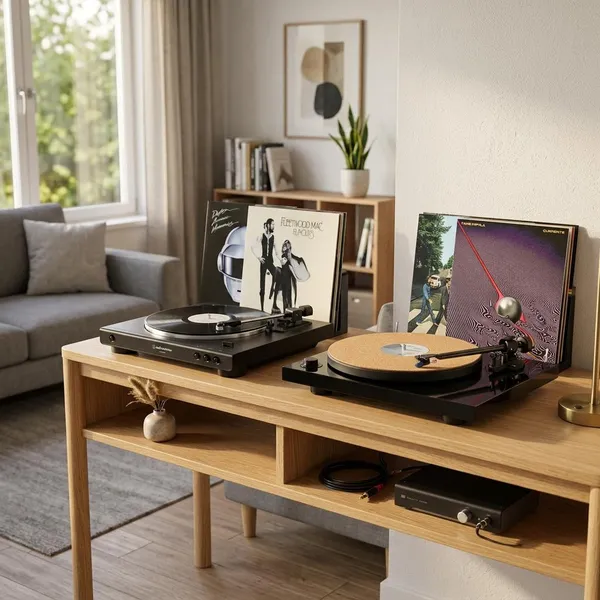
Best Vinyl Record Player Recommendations at a Glance
If you want the short version, start with your setup: powered speakers, separate hi-fi gear, Bluetooth, or no extra speakers at all. A simple automatic turntable can be the right buy for casual listening, while a more adjustable model makes more sense if you expect to upgrade later.
| Pick | Best fit | Main trade-off |
|---|---|---|
| Audio-Technica AT-LP60X | First setup with powered speakers | Limited cartridge upgrade path |
| Fluance RT82 | Best value upgrade for a hi-fi system | Needs a phono preamp or phono input |
| U-Turn Orbit Basic | Simple setup with customization options | Some convenience features depend on configuration |
| Audio-Technica AT-LP3XBT | Automatic play with Bluetooth flexibility | Wireless convenience can matter more than pure sound quality |
| Fluance RT85N | Higher-end home listening setup | Higher cost and still needs supporting gear |
| Angels Horn H019 | Compact all-in-one listening | Built-in speakers limit sound quality |
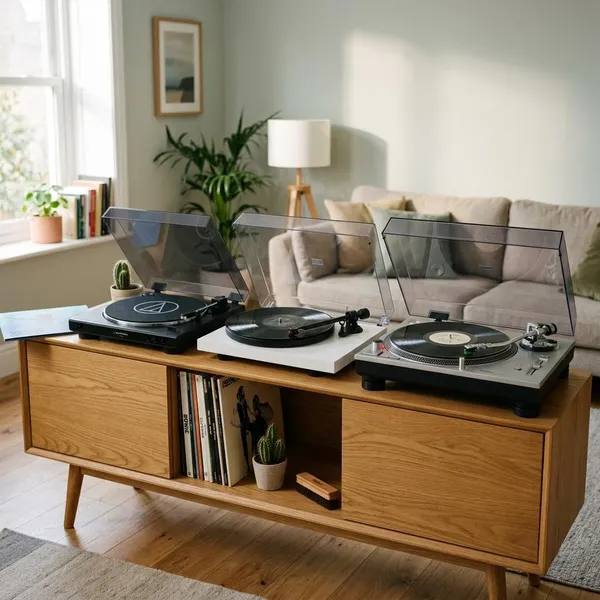
What Makes a Good Vinyl Record Player?
A good record player should keep the stylus steady in the groove, spin at a consistent speed, and keep vibration away from the cartridge. Those basics matter more than retro styling, wood-look finishes, or a long list of features you may never use.
The practical order is simple: protect the record first, keep the speed stable second, then think about upgrades and convenience. A turntable that fails at the first two can look nice and still be frustrating to live with.
Accurate tracking
Accurate tracking means the stylus sits in the groove with the right pressure and balance. If tracking is poor, you may hear distortion, skipping, or harshness on louder parts of a record, and long-term record wear becomes a bigger concern.
For casual beginners, a well-designed automatic model can be perfectly fine because the setup is mostly handled for you. For long-term listening, adjustable tracking force and anti-skate are worth having because they let you set the cartridge more carefully instead of trusting a fixed design.
Stable speed
Speed stability is one of those things you may not notice until it is wrong. Piano notes, sustained vocals, and strings can sound slightly uneasy if the platter does not hold speed well.
- Listen for wavering: long notes should not seem to bend or drift.
- Check speed controls: some turntables make 33/45 switching easier than others.
- Value consistency: steady playback often matters more than flashy extras.
Low vibration
The stylus reads tiny groove movements, so vibration from furniture, speakers, or the motor can blur the sound. A heavier plinth, better feet, and a more stable platter can help, but placement still matters.
A practical check is to look at where the turntable will sit before you buy it. A solid shelf away from booming speakers is better than a wobbly side table, even if the turntable itself is more expensive.
Replaceable stylus or cartridge
A replaceable stylus is a must-have feature because the stylus wears with use. A replaceable cartridge is even better if you want a real upgrade path later.
This is where very cheap record players often become a false economy. If the important parts are difficult to replace, the whole unit may become the thing you replace.
Flexible setup options
Flexible setup options matter because real homes are not all wired the same way. Some people need a built-in phono preamp for powered speakers; others already have a receiver with phono input and would rather keep the turntable simpler.
Bluetooth, automatic operation, and built-in speakers can all be useful, but only when they solve a real problem. If you listen every night in one fixed spot, sound quality and upgrade options should probably win. If you move rooms often or share the setup with someone who dislikes fiddly gear, convenience becomes more important.
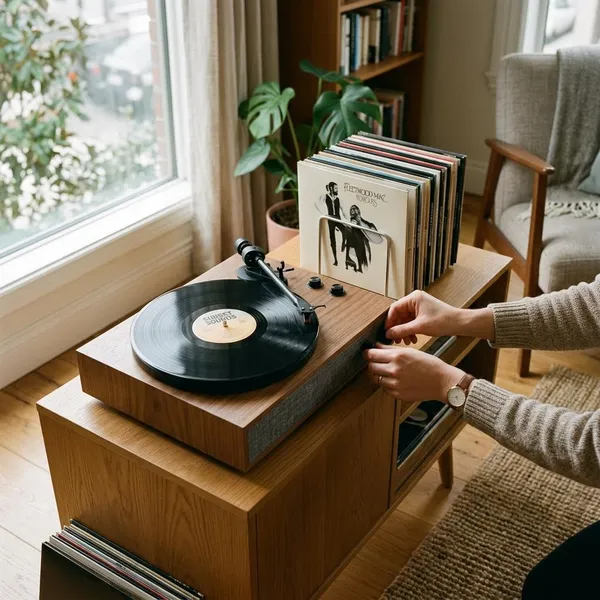
How to Choose the Right Record Player
The safest way to choose is to build the system backward from your speakers and room. A turntable that needs a separate phono preamp may be excellent, but it is the wrong first buy if you expected it to plug straight into basic speakers.
Think of the decision in this order: full budget, speaker compatibility, manual versus automatic, phono preamp, then upgrade plans. That order prevents the most common mistake: spending heavily on the deck and leaving too little for the parts that actually let you hear it properly.
Set your budget
Set the budget for the whole listening setup, not just the turntable. If you still need speakers, a receiver, a phono preamp, record cleaning supplies, or a stand, the turntable should not swallow the entire amount.
A simple beginner setup with the AT-LP60X and powered speakers can be more enjoyable than a better turntable connected to weak or mismatched gear. If you already own decent speakers and an amplifier, then putting more money into the turntable starts to make more sense.
Check your speaker setup
Check your speakers before you choose the turntable. Powered speakers need a line-level signal, which usually means the turntable must have a built-in phono preamp or you must add an external one. Passive speakers need an amplifier or receiver, and that unit may or may not include a phono input.
- Powered speakers: look for a built-in preamp or budget for an external phono stage.
- Passive speakers: confirm your amplifier or receiver can handle the turntable signal.
- Bluetooth speakers: choose a Bluetooth turntable only if wireless playback is truly needed.
- Built-in speakers: accept the convenience, but do not expect hi-fi sound.
Choose manual or automatic
Automatic turntables move the tonearm for you, which lowers the stress for beginners and shared households. Manual models ask you to cue the record yourself, but they often put more of the price into the core turntable parts.
If the record player will be used by guests, teenagers, or anyone nervous about handling the stylus, automatic play is a practical advantage. If you enjoy the ritual and want more upgrade control, manual is not hard to learn and can be the better long-term choice.
Decide if you need a phono preamp
You need a phono preamp somewhere in the chain. It may be built into the turntable, built into a receiver, or added as a separate small component.
The quick check is simple: look for "phono" on your receiver or speaker setup. If you do not have a phono input and the turntable has no built-in preamp, the sound will be far too quiet and tonally wrong until you add one.
Plan for future upgrades
If you only want occasional records on weekends, do not overbuy for upgrades you may never make. A reliable automatic turntable with powered speakers can be enough.
If you already collect records or expect to listen daily, prioritize an adjustable tonearm, replaceable cartridge, stable speed, and separate speakers. Those choices leave you room to improve one part at a time instead of replacing the whole setup later.
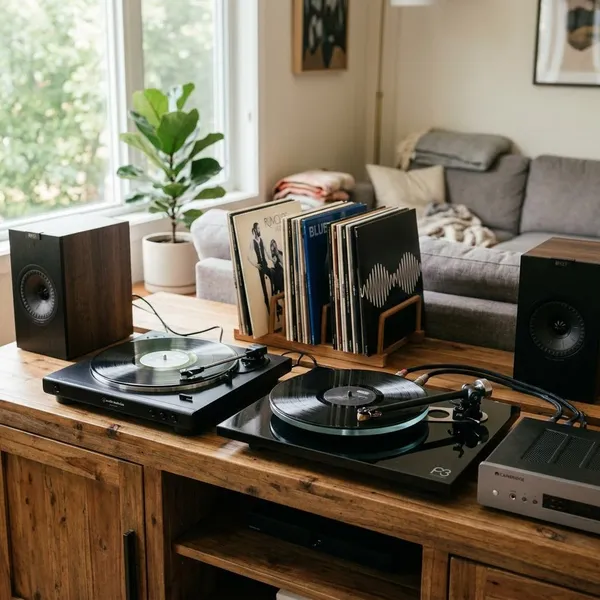
Which Vinyl Record Player Fits Your Setup?
This is where the choice becomes easier: match the player to the system you actually have, not the system you imagine buying someday. The right turntable for a small desk setup is not always the right turntable for a living-room hi-fi rack.
Use the setup notes as a final filter. If a model needs extra gear and you do not want extra gear, it is probably not your best pick, no matter how good the reviews are.
AT-LP60X for simple powered speakers
The AT-LP60X fits a simple powered-speaker setup very well because the built-in preamp removes one major compatibility problem. Put it on a stable surface, connect it to the speakers, and you have a low-stress first system.
This is the sensible choice for someone who wants records in a bedroom, home office, or apartment without turning the purchase into a full stereo project. The trade-off is that you are choosing ease over deep upgrade flexibility.
Fluance RT82 for a separate hi-fi setup
The Fluance RT82 belongs with separate components: a phono preamp or phono-equipped receiver, an amplifier if needed, and decent speakers. In that kind of setup, its better tracking and speed performance are easier to appreciate.
- Good match: bookshelf speakers, amplifier, and a listener who sits down to listen.
- Poor match: someone expecting plug-and-play use with no extra components.
U-Turn Orbit Basic for a customizable system
The U-Turn Orbit Basic is a nice fit when you want the system to feel intentionally chosen rather than prepackaged. It can suit a compact living room setup, especially if you choose a configuration that matches your speaker needs from the start.
Before ordering, check which options are included rather than assuming every Orbit Basic has the same features. That one step prevents disappointment over missing convenience touches.
AT-LP3XBT for automatic play and Bluetooth
The AT-LP3XBT works best for a modern mixed setup: maybe wired speakers now, Bluetooth headphones later, or a room where cables would be awkward. It is also friendlier for households where more than one person will use the turntable.
I would choose it over the AT-LP60X when automatic play still matters, but you want more flexibility and a more traditional tonearm setup. I would choose a non-Bluetooth hi-fi deck instead if the system is staying wired and sound quality is the main goal.
Angels Horn H019 for built-in speakers
The Angels Horn H019 is for the person who wants fewer boxes, fewer cables, and a cleaner corner of the room. It can work for casual listening in a guest room, study, or small apartment where separate speakers would be more trouble than they are worth.
Do not buy it as a shortcut to a serious hi-fi system. Built-in speakers are convenient, but separate speakers are the better choice once sound quality, stereo image, and long-term upgrades start to matter.
Conclusion
Choose the turntable that fits the system you will actually use this month, not the one that sounds most impressive on paper. The AT-LP60X is the safest easy start, the Fluance RT82 is the strongest value upgrade, and the other picks make sense when their specific convenience or setup advantage solves a real problem for you. A record player that is easy to connect, safe for normal playback, and matched to your speakers will get used more often than a "better" one that makes listening feel like homework.
FAQ
Is the Audio-Technica AT-LP60X safe for records?
Yes, it is generally safe for normal home use. It is a much better beginner choice than most cheap suitcase-style players, though it is not as adjustable as more advanced turntables.
Is the Fluance RT82 worth it over the AT-LP60X?
Yes, if you have the budget and supporting gear for it. The RT82 is worth the jump when you want better setup control and future upgrades, but the AT-LP60X is still easier for a first powered-speaker system.
Do you need separate speakers for a record player?
Most of the time, yes. Built-in speaker models exist, but powered speakers or a separate amp-and-speaker setup will usually sound fuller and give you more flexibility.
Do you need a phono preamp for a turntable?
Yes, but it does not have to be a separate box. It can be built into the turntable, built into your receiver, or added externally if neither of those already handles phono input.
Is belt drive or direct drive better for home listening?
For typical home listening, either can work well if the turntable is well designed. Belt drive is common in many hi-fi models, while direct drive can be attractive if you want strong speed control and quick start-up.