What Is the Best Way to Start Assassin's Creed?
If you are trying to choose an assassin's creed video game to play first, do not start by memorizing the whole lore. Start with the style you want: classic stealth and parkour, pirate adventure, huge RPG exploration, or a newer mix of old and modern ideas. Release order is useful, but the best starting point is usually the game that matches your patience, preferred setting, and appetite for long open worlds.
What are the main Assassin's Creed games in order?
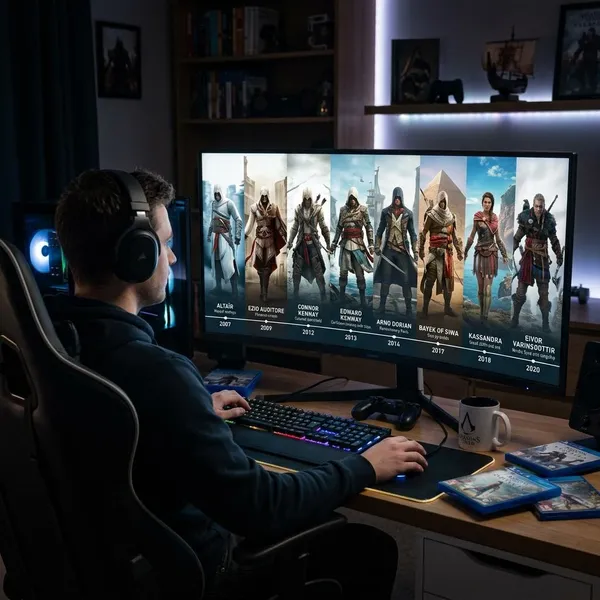
The main Assassin's Creed games make the most sense in release order because you can see the series change from city stealth to open-world RPGs and then back toward a hybrid style. If you mainly care about story continuity, especially the early modern-day plot, release order helps. If you only care about setting or gameplay feel, you can safely jump in later.
Assassin's Creed through Revelations
The first four games are the foundation of the series. Assassin's Creed introduces Altaïr, the Third Crusade setting, social stealth, rooftop movement, and target assassinations. It matters historically, but it can feel stiff and repetitive if you are used to newer open-world games.
Assassin's Creed II is the better classic starting point for most people. Ezio's story in Renaissance Italy is easier to enjoy today, the cities are more inviting, and the mission flow is much less harsh than the first game. Brotherhood continues that momentum in Rome, while Revelations closes the Ezio and Altaïr arcs in Constantinople.
Assassin's Creed III through Syndicate
This stretch is the experimental middle period. Assassin's Creed III moves into the American Revolution and adds frontier movement, hunting, and larger combat encounters. Its opening is slower, so it is not always the easiest first recommendation.
Black Flag is the standout if you want adventure first and lore second. It turns sailing, ship combat, island exploration, and piracy into the main attraction, which is why many players enjoy it even without deep series knowledge.
Origins, Odyssey, and Valhalla
Origins, Odyssey, and Valhalla are the RPG-style entries. They add levels, loot, skill trees, larger maps, and longer quest chains. Stealth still exists, but progression and combat matter much more than they did in the older games.
Origins is usually the cleanest entry point in this group because Ancient Egypt feels fresh and Bayek's story gives the big world a clear emotional center. Odyssey goes further into RPG territory with dialogue choices and a huge Ancient Greek world. Valhalla is even more of a long-term commitment, with Viking raids, alliances, settlement systems, and a very large campaign.
Mirage, Shadows, and newer entries
Mirage deliberately pulls the series back toward stealth, tools, pickpocketing, and city infiltration. Its Baghdad setting is smaller and more focused than the RPG worlds, which makes it a practical modern starting point if you do not want a 60-hour game.
Shadows takes the series to feudal Japan, a setting fans had requested for years. It fits Assassin's Creed naturally because castles, villages, political tension, stealth routes, and sword combat all support the core fantasy.
How has Assassin's Creed gameplay changed?
The biggest shift is from controlled stealth-action design to open-world RPG progression. Early games ask you to read a city and reach a target cleanly. Later RPG entries ask you to explore regions, improve your character, collect gear, and spend much more time away from the main assassination path.
Early games focused on stealth and parkour
The early games are built around movement, observation, and public spaces. You climb towers, cross rooftops, blend into crowds, watch guard routes, and look for a clean way to reach the target. Combat is there, but the fantasy is not supposed to be "fight everyone in the street."
That style is best if you enjoy planning a route more than optimizing a build. It also works well for players who prefer clear missions over a map full of icons.
Middle entries expanded combat and exploration
The middle games keep stealth in the mix but start pushing the series outward. Black Flag makes the ship feel as important as the hidden blade. Unity doubles down on dense city traversal. Syndicate adds faster tools and a more accessible pace.
RPG entries added levels, loot, and larger worlds
The RPG entries change the daily feel of play. You spend more time doing side quests, improving equipment, unlocking abilities, and entering areas where enemy strength matters. A stealth attack is not always the whole answer if your level, gear, or build is not ready for the encounter.
The upside is freedom. The downside is bloat if you prefer a direct story. Before starting Odyssey or Valhalla, ask yourself whether you enjoy clearing forts, chasing upgrades, and wandering between objectives. If that sounds like homework, start with Mirage or Assassin's Creed II instead.
Newer games blend classic and modern ideas
The newer direction tries to serve both sides of the audience. Mirage brings back a tighter city, stronger stealth tools, and more deliberate assassinations, while still feeling more modern than the older Ezio-era games.
| What you want most | Best fit | What to avoid first |
|---|---|---|
| Shorter stealth-focused play | Mirage or Assassin's Creed II | Valhalla if you dislike long campaigns |
| Big historical exploration | Origins or Odyssey | The first game if you want modern pacing |
| Standalone adventure | Black Flag | Starting only for lore completeness |
Which Assassin's Creed style is right for you?
The easiest way to choose is to ignore the size of the franchise for a moment and think about your play habits. Do you want a directed stealth campaign, a large RPG to live in, or a modern game that does a bit of both? That answer matters more than starting at the oldest title just because it came first.
Classic games for stealth and parkour
Classic Assassin's Creed is the right fit if you want cities that feel built for climbing, stalking, and escaping. Assassin's Creed II, Brotherhood, and Revelations are still the safest picks here because they show the old formula at its most confident.
RPG games for exploration and progression
Pick the RPG style if you enjoy long maps, gear upgrades, ability builds, and side quests that can pull you away from the main story. Origins is the easiest RPG-era recommendation, Odyssey is the broadest, and Valhalla is the biggest commitment.
Newer entries for a mix of both styles
Newer hybrid entries are useful when you want Assassin's Creed to feel current without becoming enormous. Mirage is the clearest example because it gives you modern presentation, a focused city, and stronger stealth identity in a more manageable package.
If you are unsure, this is often the least risky modern path. You get a taste of the series without starting with the oldest mechanics or committing to the largest RPG maps.
What historical settings does Assassin's Creed explore?
Assassin's Creed covers a wide range of historical settings, from the Crusades and Renaissance Italy to Ancient Egypt, Ancient Greece, the Viking age, and feudal Japan. The setting is not just decoration; it usually decides how the world feels, how you move through it, and what kind of fantasy the game delivers.
Crusades and Renaissance Europe
The original game uses the Third Crusade and cities such as Jerusalem, Acre, and Damascus to create a more severe, secretive atmosphere. It fits the Assassins-versus-Templars conflict well, even if the mission structure now feels dated.
Renaissance Italy gives the series its most approachable early setting. Florence, Venice, and Rome work beautifully for parkour because the buildings, rooftops, towers, and crowded streets all feed directly into how you play.
Colonial and revolutionary eras
The colonial and revolutionary games are more varied than the early European titles. Assassin's Creed III uses war, wilderness, and political conflict. Black Flag shifts the focus to the Caribbean, where ships, islands, and ports matter as much as city rooftops.
Unity brings the focus back to a dense city with Revolutionary Paris, while Syndicate uses industrial London for gangs, factories, carriages, and faster traversal. If you want to sample the series experimenting with different identities, this is the most mixed era.
Ancient Egypt and Greece
Ancient Egypt in Origins is a strong choice if you want atmosphere without immediately drowning in the biggest version of the RPG formula. Deserts, temples, tombs, rivers, and political tension give the world variety, while Bayek keeps the story grounded.
Odyssey is better if your priority is scale. Ancient Greece gives you islands, sea travel, forts, mythic flavor, and a more flexible role-playing structure. It is less compact, but it can be ideal if exploration is the main reason you play open-world games.
Viking and feudal Japanese settings
Valhalla uses the Viking age for raids, settlement growth, alliances, and a rougher version of open-world exploration. It suits players who want a long historical saga, not players looking for a quick stealth campaign.
Shadows brings the series to feudal Japan, where stealth, castles, villages, shifting loyalties, and sword combat fit the franchise naturally. If setting is your biggest deciding factor, Japan may be reason enough to start there, while still checking whether its gameplay style matches what you want.

Conclusion
The smartest starting point is not automatically the first game; it is the one that matches how you actually like to play. Choose Assassin's Creed II for classic stealth and parkour, Black Flag for a strong standalone adventure, Origins for RPG exploration, or Mirage for a newer but more focused entry. Once you know which style clicks, the rest of the series becomes much easier to navigate.
FAQ
Which Assassin's Creed game is best for beginners?
Assassin's Creed II is the best classic beginner pick, while Origins is better for players who already like open-world RPGs. If you want a newer and shorter stealth-focused option, Mirage is a safer first choice than the biggest RPG entries.
What is the newest Assassin's Creed game?
Among the major mainline releases, Assassin's Creed Shadows is the newest entry in the current sequence. Because Ubisoft continues to add projects and updates, it is worth checking the official game list if you need the latest release status at the time you buy.
How many main Assassin's Creed games are there?
Counting from the 2007 original through Shadows, there are 14 mainline Assassin's Creed games. The total gets higher if you include spin-offs, remasters, handheld games, and mobile releases.