What Makes Manhunt a Controversial Horror Game?
The manhunt video game is best understood as a grim stealth horror title, not a normal Rockstar crime game. If you are curious about it today, the main things to know are simple: it is slow, hostile, deliberately uncomfortable, and still discussed as much for its controversy as for its design.
What is the Manhunt video game?
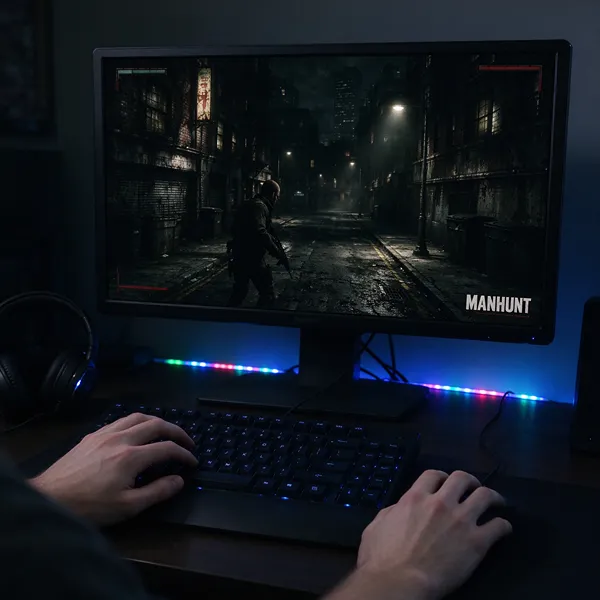
Manhunt is a 2003 stealth action game developed by Rockstar North. Instead of giving you an open city to explore, it pushes you through staged "scenes" where survival depends on hiding, listening, and striking before enemies find you.
The story follows James Earl Cash, a death row inmate who wakes up in Carcer City after what should have been his execution. A hidden director, Lionel Starkweather, forces him through a night of filmed violence while gangs hunt him through abandoned streets, industrial yards, and ruined buildings.
A 2003 stealth game from Rockstar North
Rockstar North released Manhunt in 2003, first on PlayStation 2 and later on Xbox and PC. It arrived after Grand Theft Auto III and Vice City, but it is much narrower and more claustrophobic than those games.
A dark survival story set in Carcer City
Carcer City is not a place to master or enjoy. It is a broken, hostile setting filled with gangs, surveillance, and spaces that feel abandoned rather than explorable. That matters because the city supports the main feeling of the game: Cash is not on an adventure, he is being pushed through a controlled nightmare.
Starkweather's voice in Cash's ear gives the story its cruel edge. He is not just an antagonist at a distance; he comments, directs, and pressures the player, which makes each scene feel less like a normal level and more like a staged performance.
A game known for its violent and disturbing tone
Manhunt is remembered because its violence is presented as ugly, close-range, and intentionally uncomfortable. The grainy visual style, harsh audio, and snuff-film framing make the game feel grim rather than empowering.
How does Manhunt gameplay work?
Manhunt plays best when you treat every area as a risk problem: where is the shadow, who is moving, what can be heard, and what happens if the first attack fails? The game usually punishes rushing more than waiting.
The campaign is divided into 20 scenes. Each scene gives you a hostile space to cross, enemies to avoid or remove, and a performance rating at the end. The basic loop is easy to understand, but the tension comes from timing and limited safety.
Hide in shadows to avoid hunters
Shadows are the first thing to look for when entering a new area. If Cash is hidden in darkness, enemies have a much harder time spotting him, which gives you time to watch, breathe, and plan the next move.
Watch enemy movement before attacking
Patrols decide whether an attack is safe. One hunter may look isolated, but another can turn a corner during the execution or hear the aftermath. Before committing, check whether the target is truly alone or only briefly separated.
Use noise to lure enemies away
Noise lets you control a scene without stepping into the open. A thrown object or other distraction can pull a hunter away from a group, shift attention from a route, or create a cleaner path through a crowded space.
This is especially useful for cautious players who want to avoid messy combat. Instead of fighting two or three enemies together, you can create a smaller problem and handle it on your own terms.
Choose between stealth and direct combat
Direct combat exists, but it is rarely the comfortable choice. Melee fights can be clumsy, and firearms change the rhythm by making encounters louder and less controlled. Stealth usually gives you the best chance of keeping health and positioning intact.
| Situation | Better approach | Why it matters |
|---|---|---|
| One enemy near shadow | Wait and use stealth | Low risk if no patrol is nearby |
| Several enemies close together | Lure one away first | Avoids being surrounded |
| Tight space with no cover | Move quickly or fight if forced | Waiting may not improve the odds |
| Firearm-heavy scene | Use cover and timing | Noise becomes harder to avoid |
Earn ratings by how you clear each scene
Scene ratings give the game a performance layer. You are not only trying to survive; the game also judges how efficiently and violently you handled the scene.
For a first playthrough, survival is the smarter priority. If you replay scenes later, ratings become more interesting because you can test faster routes, cleaner stealth, or higher-risk executions without treating every mistake as a full setback.
How does the execution system work?
The execution system is the mechanic most closely tied to Manhunt's reputation. To use it, you get behind an unaware enemy, hold the attack button, and release it after the execution level builds.
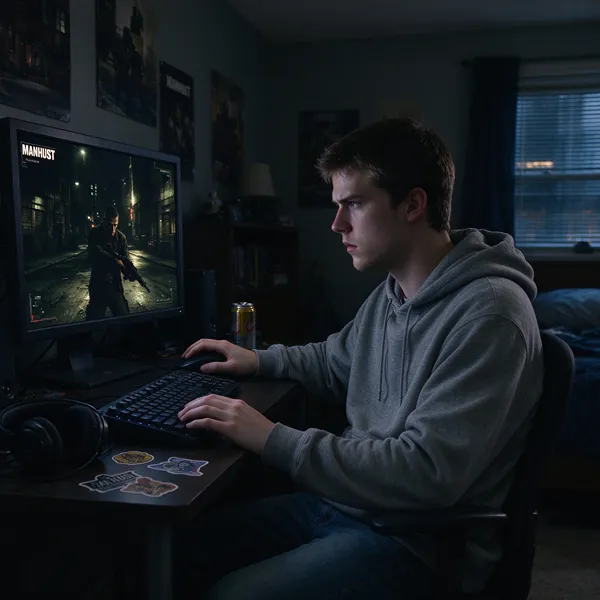
Hold an attack to build intensity
Holding the attack button increases the execution intensity. That small delay creates the whole risk-reward choice: release early and stay safer, or wait longer and risk losing the opening.
Timing determines the execution level
The timing of your release determines the level of the execution. Longer holds lead to more severe animations, while shorter holds keep the action quicker.
In practical play, the best timing depends on the room. A lonely target in a wide area gives you more freedom. A target near crossing patrols usually calls for a faster, less ambitious takedown.
Longer setups bring more risk
A longer setup can fail simply because the world keeps moving. Another enemy may walk into view, the target may shift, or your escape route may become unsafe. That is why the more dramatic option is not always the smarter one.
Higher-risk executions affect ratings
Higher-risk executions can improve ratings because the game rewards more intense performance. That design is also why the system drew so much criticism: it did not only show violence, it connected violence to scoring.
If you are playing out of curiosity rather than completionism, you do not need to chase the harshest option every time. The game can be finished with a more cautious approach, even if ratings are not perfect.
Why was Manhunt so controversial?
Manhunt became controversial because its violence was not incidental. The whole premise, presentation, and rating system are built around staged killings, and that made it an easy target in debates about video game violence.
The backlash was intensified by Rockstar's profile. A small horror game might have stayed niche, but a Rockstar release drew attention from media outlets, regulators, parents, and politicians. The result was a reputation that often overshadowed the stealth design itself.
Graphic violence drew heavy criticism
The close-range executions were the main source of criticism. They were framed slowly, with harsh sound and grim camera treatment, so they felt more personal than ordinary action-game combat.
Even though the graphics are dated now, the intent is still clear. The game wants the violence to feel dirty and uncomfortable, which is exactly what supporters call effective horror and critics call exploitative.
Execution mechanics intensified the backlash
The execution system made the controversy harder to dismiss because the player actively chooses how long to hold and how severe the takedown becomes. Critics focused on that interaction, not just the images on screen.
This is the key difference between Manhunt and many violent games from the same era: the debate was about participation and reward, not only depiction.
Regional bans and classification disputes followed
Some regions restricted, banned, or heavily scrutinized Manhunt, while others allowed it with age ratings. Exact availability has varied by country and platform over time, so modern buyers should check their local storefront rather than assume it is listed everywhere.
Media coverage shaped its reputation
Media coverage often reduced Manhunt to one idea: one of the most violent games of its time. That label stuck, especially among people who never played it.
Players who revisit it tend to talk about more than the controversy: the sound design, pressure, ugly atmosphere, and strict stealth loop all matter. Still, the public image of the game was largely shaped by outrage first and design discussion second.
Where can you play Manhunt today?
You can still find ways to play Manhunt, but the best option depends on your region, hardware, and tolerance for older games. Check current storefront listings before buying, because availability can change.
PC through Steam
PC through Steam is often the most convenient route when the game is available in your region. It avoids old hardware and is usually the simplest option for someone who wants to sample the game rather than collect it.
The caution is that older PC releases can need small adjustments. Before buying, it is worth checking recent user notes about controller support, display behavior, or compatibility fixes on modern systems.
PS4 through the PlayStation Store
The PS4 version, where available through the PlayStation Store, is a good fit for players who want a console setup without buying a PS2. It is also more approachable if you prefer playing from a couch rather than troubleshooting a PC release.
Do not assume every region has the same listing. Search your own PlayStation Store first, and check whether the version being sold is the PS2-on-PS4 release or another regional offering.
PS5 through PS4 backward compatibility
If you own or can buy the PS4 version, PS5 backward compatibility may let you play it on newer hardware. That is convenient, but it does not make Manhunt feel like a modern remake.
This route suits someone who wants quick access to a piece of Rockstar history. It is less ideal if you expect updated controls, cleaner camera behavior, or major quality-of-life improvements.
Original PS2 and Xbox copies
Original PS2 and Xbox copies are the collector's route. They give you the closest experience to how the game was originally played, including the old controller feel, display quirks, and hardware limitations.
- Choose this if: you collect physical games or care about authenticity.
- Be careful with: disc condition, console reliability, cables, and regional compatibility.
- Skip it if: you only want a quick, low-effort way to try the game.
Conclusion
Manhunt is worth approaching as a harsh, historical stealth horror game rather than a polished modern action title. If you can accept dated controls and an intentionally unpleasant tone, it remains a memorable look at how mechanics, atmosphere, and controversy can become impossible to separate.
FAQ
Is Manhunt a horror game or a stealth game?
It is both, but stealth is the main way you play. The horror comes from the pressure, sound design, setting, and the feeling of being watched rather than from monsters or jump scares.
Is Manhunt connected to Manhunt 2?
Manhunt 2 is a sequel, but it does not continue James Earl Cash's story directly. You can play either game first, though the original gives useful context for the series' tone and reputation.
Is a new Manhunt game confirmed?
No new Manhunt game has been officially confirmed. Rumors appear from time to time, but there has been no reliable public announcement of a sequel, remake, or reboot.