How Do You Play the Classic Asteroids Game?
Asteroids looks simple until the ship starts drifting and the screen fills with fragments from every direction. The basic idea is to rotate, thrust, shoot rocks apart, avoid saucers, and stay alive long enough to build a better score, but the real skill is controlling space before the screen becomes crowded.

How do you play Asteroids?
You play Asteroids by piloting a small ship in a wraparound space arena. Your ship can rotate, thrust forward, fire shots, and use hyperspace in emergencies. The goal is not just to shoot everything quickly; it is to break asteroids apart without creating a mess you cannot escape.
Rotate and thrust the ship
The ship does not move like a character in a modern twin-stick shooter. You rotate left or right, point the nose where you want to go, and apply thrust to accelerate forward. Once you move, inertia keeps carrying the ship, so every burst of speed has a consequence a few seconds later.
For a new player, the safest habit is to tap thrust rather than hold it. Short bursts help you adjust position without turning the whole screen into a chase you cannot control.
Shoot asteroids into smaller pieces
Shooting a large asteroid breaks it into smaller pieces, and those smaller pieces are usually harder to manage. That means every shot should answer a simple question: will this make the screen safer, or will it create faster threats too close to my ship?
- Large asteroid far away: safe to split if you have room to react.
- Large asteroid close by: move first, shoot after you create space.
- Small asteroid near you: treat it as urgent, even if it looks less dramatic.
Avoid rocks and flying saucers
Asteroids end your ship on contact, while flying saucers add gunfire to an already busy screen. The hardest moments often come when these threats overlap: you dodge a rock, drift into a saucer shot, then panic-thrust into a wrapped asteroid.
When a saucer appears, do not tunnel-vision on it unless the path around your ship is clear. In a low-risk moment, taking the saucer out quickly can help. In a crowded corner, survival comes first.
Survive and build a higher score
The original Asteroids is built around score chasing rather than finishing a story or reaching a final boss. Your score rises as you destroy asteroids and saucers, but the best runs usually come from controlled play, not constant firing.
If you are playing for a quick casual run, focus on lasting longer than your previous attempt. If you are chasing a serious high score, screen control matters more: clear dangerous fragments, avoid unnecessary speed, and do not split several large rocks at once just because you can.
Why is Asteroids so difficult?
Asteroids is difficult because the rules are simple but unforgiving. You can usually see why you lost: too much speed, a bad split, a missed edge wrap, or a saucer that forced you into a poor move. The game rarely needs complex systems to create pressure because its movement and screen layout already do that work.
The main thing to understand is that danger builds from your own actions. Shooting clears threats, but it also creates new ones. Moving saves you, but too much movement can remove your control.
Inertia makes movement tricky
Inertia is the first wall most beginners hit. The ship keeps drifting after you stop thrusting, so escaping one asteroid can carry you straight into another. This is why panic movement feels helpful for half a second and dangerous right after.
Smaller asteroids move faster
Small asteroids are dangerous because they give you less time to aim, turn, and dodge. A screen with only a few tiny fragments can be more threatening than a screen full of big slow rocks.
Screen wrapping creates surprise threats
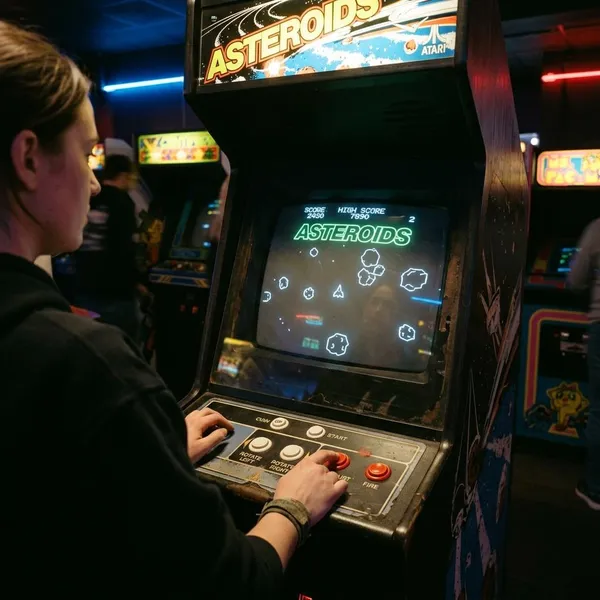
Nothing truly leaves the playfield. Asteroids, shots, saucers, and your ship can exit one side of the screen and reappear on the opposite side, which makes the edges feel less like walls and more like doors.
That rule changes how you should scan the screen. Do not only watch what is in front of the ship. Check where objects are leaving the edge, because that is often where the next collision will come from.
Flying saucers add extra pressure
Flying saucers make the game harder because they interrupt your rhythm. Asteroids drift in patterns you can learn, but saucers cross the screen and fire while you are already managing momentum.
If the saucer appears while you have open space, it can be worth dealing with quickly. If it appears while fragments are near your ship, your first job is to avoid being forced into a bad dodge. The saucer is dangerous, but a careless chase can be worse.
Beginner tips for Asteroids
The fastest way to improve is to stop treating Asteroids like a pure shooting game. Think of it as a control game first: keep your speed low, keep space around the ship, and remove the threats that can hit you soonest.
Use this priority order when a wave starts to feel messy:
- First: protect the space immediately around your ship.
- Second: clear small or fast fragments that are near your path.
- Third: split larger asteroids only when you have room.
- Last resort: use hyperspace if a normal dodge is no longer possible.
Use thrust in short bursts
Tap thrust to make small adjustments instead of holding it down. A short burst can move you away from danger while still leaving time to rotate, aim, and correct your drift.
This advice matters most when you are still learning the controls. Experienced players may carry more speed on purpose, but beginners usually survive longer by moving less and reading the screen more.
Clear small asteroids quickly
Nearby small asteroids should usually move to the top of your target list. They are harder to hit, cross space faster, and can punish even a slight delay.
Watch every edge of the screen
Train yourself to glance at all four edges, especially after you shoot near a border. A fragment that disappears to the left can return from the right before you are ready, and saucers can create the same kind of surprise pressure.
Keep space around your ship
Open space is your safety buffer. If you can rotate freely and make one or two small corrections, you still have choices. If rocks are close on several sides, even a good shot can create fragments you cannot avoid.
- Safer position: open center area with slow drift and clear escape lanes.
- Risky position: corner or edge with fragments wrapping in nearby.
- Bad habit: chasing points into a crowded cluster instead of resetting your position.
Use hyperspace only when desperate
Hyperspace can save a doomed ship, but it is not a dependable escape plan. It sends you to a random place, which means you may avoid one collision and land near another threat.
Use it when the alternative is almost certainly losing the ship: a collision you cannot dodge, a saucer shot with no lane, or a crowded screen where thrust would only make things worse. If there is still a controlled move available, take that instead.
Where can you play Asteroids today?
You can still play Asteroids through official collections, modern versions, and Atari-branded hardware. The best choice depends on whether you want the classic arcade feel, a refreshed version, or a broader retro setup.
| Best fit | Option to consider | Why it makes sense |
|---|---|---|
| Classic arcade feel | Atari 50 | Good for playing the original in an official collection. |
| Modern quick sessions | Asteroids: Recharged | Better if you want updated visuals and a newer presentation. |
| Retro hardware interest | Atari VCS | Makes more sense if you want more than one Atari game. |
Atari 50 for the classic game
Atari 50 is the easiest recommendation if you want the original Asteroids experience on modern systems. It is especially useful for players who care about the classic version but do not want to hunt down an arcade cabinet or vintage hardware.
Asteroids: Recharged for a modern version
Asteroids: Recharged is better if you want the idea of Asteroids with a fresher look and more modern energy. It is not the same historical experience as the 1979 arcade game, but it can feel more approachable if minimalist vector graphics are not your thing.
Atari VCS for official retro play
The Atari VCS is a more specific choice. It makes sense if you like Atari-branded hardware, want a dedicated retro-style setup, or plan to explore more of the Atari library.
If you only want to play Asteroids once or twice, a collection or modern release is usually the more practical route. If the appeal is having an Atari-centered living room setup, the VCS becomes easier to justify.

Conclusion
Asteroids still works because it makes every small choice matter: when to thrust, when to shoot, when to leave a rock alone, and when to stop chasing points long enough to stay alive. If you are new, play for control before score; once the movement starts to feel natural, the game's challenge becomes much more satisfying.
FAQ
What does hyperspace do in Asteroids?
Hyperspace instantly moves your ship to a random spot on the screen. Use it only when a normal dodge is unlikely to work, because the new position can also be dangerous.
Does the original Asteroids have an ending?
No. The original Asteroids is an endless arcade score game, so the run continues until you lose all your ships.
Can you play Asteroids on Nintendo Switch?
Yes, Asteroids is available on Nintendo Switch through releases such as Atari 50 and Asteroids: Recharged, depending on current store availability in your region.