How Do You Survive an SCP Containment Breach?
If you are trying the SCP Containment Breach video game for the first time, expect a horror game about escaping, not fighting. Your first priorities are simple: find better access, manage blinking, save stamina, and learn which SCP rules can kill you instantly. Start on a forgiving difficulty if you want to understand the systems before the game starts punishing every mistake.
How does SCP Containment Breach gameplay work?
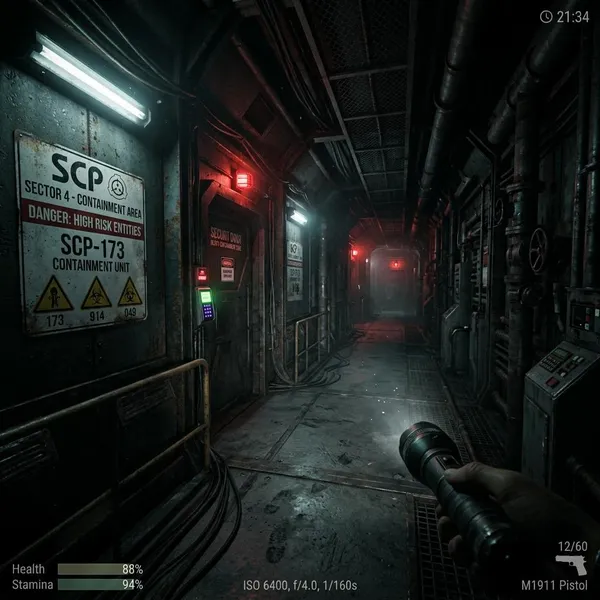
SCP Containment Breach is built around a tense loop: explore the facility, collect items, unlock new areas, avoid SCPs, and search for a way out. There is no normal combat solution, so the game rewards awareness more than aggression. A safe-looking corridor can become dangerous because your blink meter is low, your stamina is empty, or the next room gives you no clean escape route.
The most useful way to think about a run is priority-based:
- Get a usable keycard or a way to improve one.
- Keep enough stamina for sudden danger, not hallway travel.
- Watch your blink meter before opening doors or entering tight spaces.
- Use SCP-914 only when the reward is worth the time and risk.
- Move toward an exit path once your access level and supplies allow it.
Explore the changing facility
The facility layout changes between runs, so memorizing one perfect route will not carry you very far. What does help is learning room types: which rooms tend to hold supplies, which ones are mainly lore, and which ones are risky because they leave you trapped if something appears behind you.
For a first-time player, slow exploration is usually better than sprinting into every branch. If you already have a useful keycard and enough supplies, skipping a suspicious dead end can be the smarter choice. Curiosity keeps the game interesting, but unnecessary detours are one of the easiest ways to lose a good run.
Manage blinking and stamina
Blinking and stamina are not background meters; they are survival resources. Blink before opening a risky door if the meter is nearly empty, and avoid spending all your stamina just to move faster through quiet areas. The common beginner mistake is arriving at the real danger with no blink control and no sprint left.
Find keycards and useful items
Keycards matter because they decide how much of the facility you can actually use. A better card can open safer routes, supply rooms, checkpoints, and later progression paths. If your inventory is full, keep items that create options rather than items that only feel comforting.
- High priority: stronger keycards and items needed for progression.
- Useful backup: healing supplies, batteries, and protective gear for specific areas.
- Easy to overcarry: duplicate low-value items that do not solve your current problem.
Avoid SCPs and search for an exit
Escaping is less about moving forward at all costs and more about staying in control. If a route becomes unsafe, backing out early is often better than forcing progress through a bad corridor. This is especially true in a run where you already have good access; losing everything for one unnecessary room rarely pays off.
Use SCP-914 to alter items
SCP-914 can upgrade or change items depending on the setting used, and it is often most valuable for improving keycards. Treat it like a risky stop, not a playground. Bring the item you want to improve, process the important upgrade first, and leave before the room becomes a trap.
If you are learning the game on Safe difficulty, experimenting with SCP-914 can be useful because mistakes are easier to recover from. On a stricter run, especially when saving is limited, random testing is much harder to justify unless you already know what you are trying to get.
Major SCP threats in Containment Breach
The major threats are scary because they do not all punish the same behavior. One asks you to keep looking, another makes routes unreliable, and another can punish careless camera movement. Once you learn those rules, the game still feels tense, but it feels less unfair.
SCP-173
SCP-173 is the threat that makes blinking dangerous. It cannot move while you are watching it, but a badly timed blink or a careless turn can close the distance instantly. Keep it in view, create space when possible, and do not let panic push you into corners or awkward door interactions.
SCP-106
SCP-106 is dangerous because it breaks your confidence in a route. A hallway that felt safe can suddenly become unusable, so the best response is usually decisive movement rather than hesitation.
- Keep track of nearby intersections.
- Avoid committing too deeply to dead ends.
- Close doors when it buys time, but do not stop moving just to be tidy.
SCP-049
SCP-049 punishes slow looting and poor positioning. Before you search a room, ask yourself how you would leave if danger entered from the obvious doorway. That check sounds simple, but it keeps you from getting trapped in enclosed rooms with no stamina and no plan.
This is where casual and careful play split. If you are playing mainly for atmosphere on an easier setting, you can afford to inspect more rooms. If you are trying to finish a serious run, leave earlier than your curiosity wants you to.
SCP-096
SCP-096 is dangerous because seeing its face can trigger a lethal response. The safer habit is camera discipline: do not swing your view wildly through unknown spaces, especially when you are already nervous or running from something else.
When you suspect SCP-096 may be nearby, slow your scanning and avoid forcing your view into every corner. In this encounter, gathering information too aggressively can be worse than knowing a little less.
SCP Containment Breach difficulty levels
Difficulty mainly changes how costly mistakes become, especially through saving rules. The best choice depends on whether you want to learn the game, play it as a tense horror challenge, or test whether you can complete a run cleanly.
| Difficulty | Best for | Main trade-off |
|---|---|---|
| Safe | New players learning rooms and SCP behavior | Less punishment, but still tense |
| Euclid | Players who understand the basics | Better tension with limited recovery |
| Keter | Experienced players seeking pressure | One death can end the run |
| Custom | Players who want specific settings | Balance depends on what you change |
Safe for saving anywhere
Safe is the best starting point if you want to learn without repeating the same early rooms for hours. Save before risky experiments, before using SCP-914, and before entering unfamiliar sections. It will not remove the horror, but it gives you room to understand why you died.
Euclid for limited saving
Euclid is a good next step once you can handle blinking, stamina, and the main SCP behaviors without constant panic. Limited saving makes decisions feel heavier, but the mode still gives enough room to recover from normal mistakes.
If Safe starts to feel too forgiving, Euclid usually gives the better version of the game's tension. You still learn, but careless movement costs more.
Keter for permadeath
Keter is for players who already know what a bad room, bad blink, or bad route choice looks like. Permadeath changes your decision-making: you skip more optional rooms, avoid unnecessary SCP-914 experiments, and value safe positioning more than speed.
Custom for tailored difficulty
Custom difficulty is useful if one part of the game is blocking your enjoyment. You might want easier saving while still keeping enemy pressure, or you might want a harsh survival feel without fully committing to permadeath. It is also a sensible option for horror fans who want the atmosphere more than a strict challenge run.
Beginner tips for SCP Containment Breach
Learn when to blink
Do not wait until the blink meter forces the issue in a dangerous doorway or tight corridor. If you have a quiet moment and enough distance, blink on your terms. This matters most when SCP-173 could appear, because the difference between a controlled blink and a forced blink can decide the run.
Save stamina for danger
Walk when nothing is chasing you. Sprinting everywhere feels faster, but it turns sudden danger into a dead end because you have no emergency reserve. Save stamina for long corridors, bad turns, and moments when you need to break contact quickly.
Keep useful keycards
A keycard that opens new areas is usually worth more than an item that only helps once. If you must drop something, ask which item gives you access, recovery, or survival in more situations. That quick inventory check prevents a lot of frustrating backtracking.
Learn each SCP's behavior
Do not use one panic response for every SCP. Looking at SCP-173 helps, looking at SCP-096 can be disastrous, and running blindly from SCP-106 may lead you into a worse route.
After a death, think about the specific mistake rather than blaming bad luck immediately. Did you enter a room with low blink? Did you waste stamina earlier? Did you stare into an unknown area too quickly? Those details are the fastest way to improve.
Explore SCP-914 carefully
Use SCP-914 with a goal. For most beginner runs, upgrading a keycard is the clearest reason to go there because it affects the rest of the facility. If the path to SCP-914 is dangerous and your current access is already decent, skipping it can be a better decision than risking the run for extra experimentation.
Conclusion
SCP Containment Breach works best when you stop treating it like a game you can brute-force and start treating every meter, doorway, and detour as a decision. New players should learn on Safe or Custom, move to Euclid when the basics feel steady, and save Keter for runs where losing everything sounds exciting rather than exhausting.
FAQ
Is every SCP Containment Breach map different?
Yes, runs usually use procedural generation, so the layout changes. You can still learn room types and danger patterns, but you should not rely on one memorized route.
Is SCP Containment Breach based on the SCP Wiki?
Yes. It adapts the SCP Wiki universe into a survival horror game, though the game's pacing, rooms, and scenarios are its own playable interpretation.
Does SCP Containment Breach have multiple endings?
Yes. Different final routes and choices can lead to different endings, which gives experienced players a reason to replay after they understand the systems.
Is there an official SCP Containment Breach 2?
No widely recognized official sequel called SCP Containment Breach 2 exists. If you want to play today, look for a stable, actively maintained version or community-supported edition of the original.