What Are Rampage's History, Gameplay, and Monsters?
The rampage video game is best understood as a loud, simple arcade idea that still works: pick a giant monster, climb buildings, smash the city, and survive long enough to move to the next one. If you are coming to it today, expect a score-chasing arcade game rather than a story-heavy monster adventure.
What is the Rampage video game?
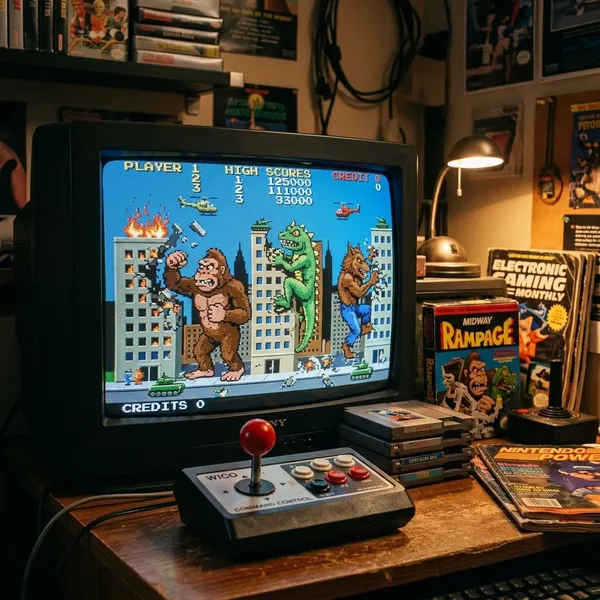
Rampage is a side-view action arcade game where players control giant monsters instead of fighting against them. The goal is direct: wreck every building on the screen while dealing with soldiers, tanks, helicopters, and whatever strange items appear inside the city.
A 1986 arcade game from Bally Midway
Rampage was released in arcades in 1986 by Bally Midway and was created by Brian Colin and Jeff Nauman. Its monster-movie premise was easy to read from across an arcade: three huge creatures tearing apart a city while the military tries to stop them.
The arcade origin matters because the design is built around quick understanding. You do not need a long tutorial, a map, or a complicated move list. One coin, one monster, one city to flatten.
A city-smashing action game
The game is not about protecting a city or defeating a final boss. Progress comes from destroying the buildings themselves. Each hit breaks more of the structure, and a stage ends when the skyline has been reduced to rubble.
- Best for: quick arcade sessions, retro nights, and players who enjoy simple visual chaos.
- Not the best fit for: players expecting modern physics, upgrades, or a long campaign.
- First thing to understand: destruction is the objective, not just a visual effect.
A three-player monster experience
One of the original cabinet's strongest hooks was three-player support. George, Lizzie, and Ralph could all be on screen together, which turned a simple action game into a messy social one.
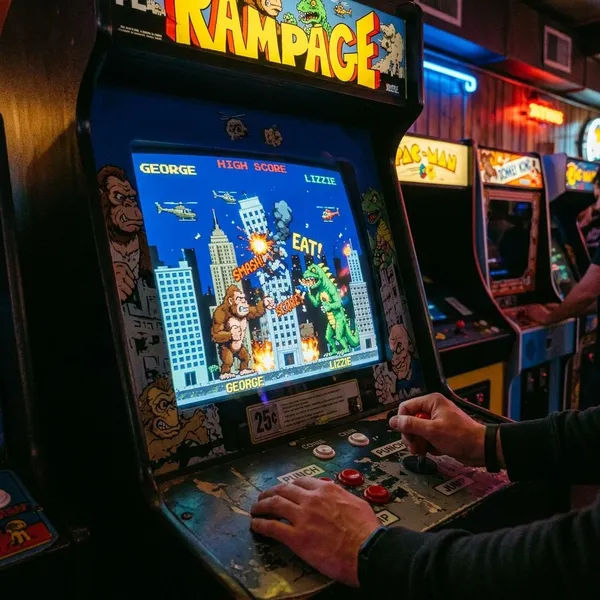
If you are playing with friends today, this is still the version of Rampage that makes the most sense: one person climbs too slowly, another steals the food, and someone else gets knocked around by helicopters. Solo play works, but the game's personality is much stronger when multiple players share the same collapsing city.
How does Rampage gameplay work?
The basic loop is easy to follow. Enter a city, climb the buildings, punch them apart, grab useful items when you can, and avoid taking too much damage from the military. Once every building is gone, the game moves on to the next city.
The important thing is not to treat Rampage like a pure button-masher. Smashing fast helps, but staying in one place too long usually gets your monster shot down. A better rhythm is to damage a building, move when enemies crowd you, and grab health only when it will not cost more damage than it restores.
Climb and smash buildings
Climbing is the action that makes Rampage feel different from a standard brawler. Your monster can scale a building, punch through walls, break windows, and slowly tear the structure down floor by floor.
Eat people and food for health
People and food appear as you smash into buildings. Some items help restore health, while others can hurt you or waste precious time. That little bit of uncertainty keeps the game from being pure destruction.
- Grab health quickly when enemy fire is light.
- Ignore risky items if tanks or helicopters are already draining you.
- Do not chase every window when the stage is nearly finished.
Fight soldiers, tanks, and helicopters
The city fights back from several directions. Soldiers shoot from windows and rooftops, tanks pressure you from the street, and helicopters punish you when you linger too high for too long.
For a new player, helicopters are often the most annoying threat because they follow the monster's height and interrupt climbing. Tanks are easier to notice, but they become a problem when you drop to the ground carelessly after smashing a building.
Destroy the city to move on
A stage is cleared when the buildings are gone. There is no hidden objective to overthink, which is part of the appeal: if a structure is still standing, it still needs to come down.
For short casual play, that clarity is perfect. For longer sessions, the challenge comes from endurance. The rules stay familiar, but the pressure builds as enemies keep draining health while you try to finish each city efficiently.
Main monsters in Rampage
The original Rampage is built around three monsters: George, Lizzie, and Ralph. They are simple characters, but that simplicity works in an arcade setting. Each one is instantly recognizable, which matters when three players are moving around the same busy screen.
Their backstories are intentionally silly rather than serious horror. That tone is important: Rampage borrows from monster movies, but it plays the destruction for comedy and spectacle.
George the giant gorilla
George is the giant gorilla and the character most closely associated with the series. He fits the building-climbing fantasy immediately, which makes him the easiest monster to understand at a glance.
His original backstory says he was changed by an experimental vitamin, which tells you almost everything about the game's sense of humor. Rampage is not trying to explain its monsters realistically; it just wants them to be fun to play.
Lizzie the giant lizard
Lizzie is the giant lizard, sometimes written as Lizzy in discussions of the series. She brings the classic radioactive-reptile feel to the roster and gives the game a strong monster-movie flavor beyond the giant ape idea.
In multiplayer, Lizzie's shape also helps with readability. When the screen fills with explosions and falling walls, clear silhouettes make it easier to keep track of your own character.
Ralph the giant werewolf
Ralph rounds out the trio as the giant werewolf. His strange food-additive origin is another reminder that the game is playful first and logical second.
He is important because the original cabinet was not just "the gorilla game." With Ralph included, three players could join at once, and each person had a distinct monster rather than a recolored version of the same character.
Why did Rampage stand out in arcades?
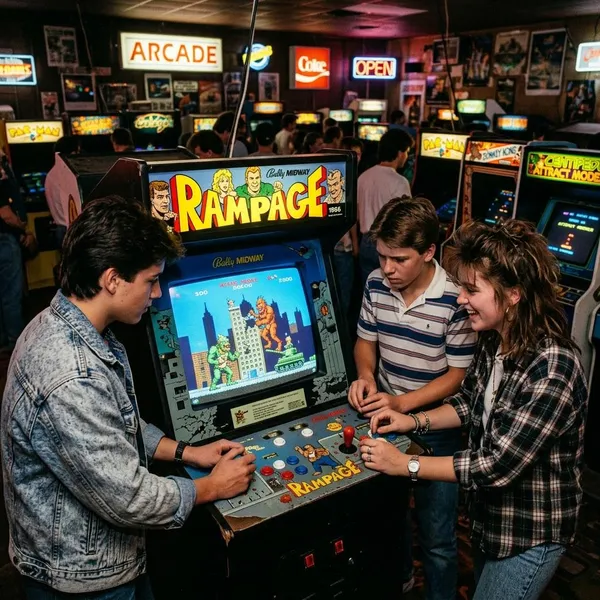
Rampage stood out because it had a hook people could understand instantly. A player did not need to know the rules to see why the cabinet looked fun: monsters were climbing buildings, punching holes in walls, and causing exactly the kind of trouble most games asked you to prevent.
Its real strength was the combination of role reversal, visible destruction, and group play. Many arcade games had one strong idea. Rampage had several that worked together without making the game hard to learn.
Players became the monsters
Controlling the monster was the game's smartest twist. Instead of rescuing civilians or stopping a threat, players became the threat, which made the whole game feel mischievous before a single building fell.
That role reversal is still the main reason to try the original today. If you only have ten minutes with a retro machine or collection, Rampage delivers its core fantasy almost immediately.
Destruction drove the action
The buildings are not background scenery. They are the target, the progress marker, and the spectacle all at once.
That design gives every punch a visible result. A wall breaks, a window opens, a person appears, or another piece of the city disappears. Even spectators can tell what is happening, which was a major advantage in a noisy arcade.
Three players could join at once
Three-player action made the cabinet more social than many arcade games of its era. Friends could cooperate, compete for items, or accidentally make each other's survival harder.
Simple controls made it easy to play
Rampage works because the controls are simple enough for almost anyone to try. Move, climb, jump, attack, and react to what appears on screen.
That does not make the game shallow in the moment. The challenge comes from timing and attention: knowing when to keep smashing, when to move away, and when a health item is worth the risk.
Conclusion
Rampage still earns its classic status because it turns one clean idea into a memorable arcade experience: let players be the monsters and make the city the playground. If you want the most authentic feel, look for a version with local multiplayer and simple arcade-style controls; if you want depth or modern spectacle, later monster games may suit you better.
FAQ
Who created the original Rampage game?
Brian Colin and Jeff Nauman created the original Rampage. Bally Midway released it as an arcade game in 1986.
Is Rampage a multiplayer game?
Yes. The original arcade version supports up to three players at the same time, with George, Lizzie, and Ralph each controlled separately.
Was Rampage originally an arcade game?
Yes. Rampage started as a 1986 arcade release before being ported to home systems such as the NES, Atari 7800, and MS-DOS.
What was the last Rampage video game?
The last major game release was Rampage: Total Destruction in 2006. Later interest in the name came partly from the 2018 live-action film rather than a new main game.