What Are SOMA's Story, Gameplay, and Themes?
SOMA is worth playing if you want a horror game that unsettles you through story, atmosphere, and big questions rather than combat. The soma video game is slower than action horror, but that is the point: it gives you time to feel trapped, curious, and increasingly unsure about what "survival" even means.
What is the SOMA video game?
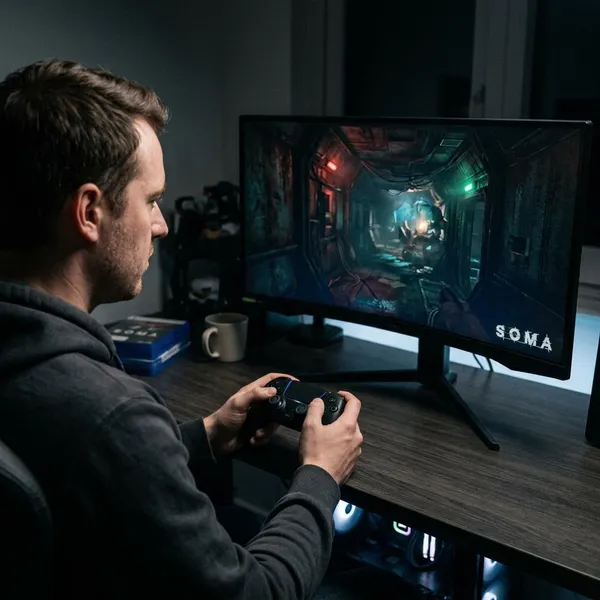
SOMA is a first-person sci-fi horror game set in a ruined underwater research facility. It is best approached as a tense story experience with exploration, stealth, environmental puzzles, and philosophical horror, not as a game about fighting monsters or building combat skill.
A sci-fi horror game from Frictional Games
Frictional Games, the studio behind Amnesia, made SOMA with the same basic horror instinct: make the player feel exposed. The difference is the setting. Instead of gothic halls and old-world terror, SOMA uses broken machines, decaying labs, ocean pressure, and questions about copied minds.
That shift matters because the fear is not only "something is chasing me." Often, the more disturbing part is realizing what a machine used to be, why a voice still thinks it is human, or why a "solution" may not save the person you think it saves.
A first-person story beneath the Atlantic
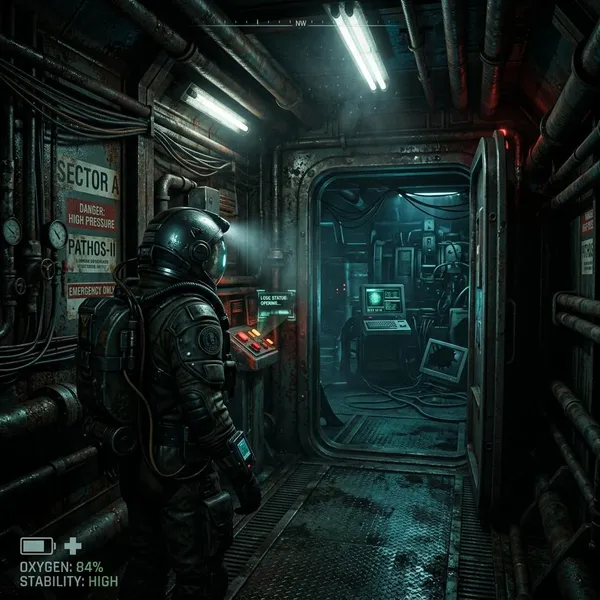
Nearly all of SOMA takes place in PATHOS-II, a research facility deep under the Atlantic after a catastrophe has ruined the surface world. The first-person view keeps the experience intimate: you are not watching Simon from a distance, you are moving through the same sealed corridors and ocean-floor passages he is trying to understand.
The underwater setting does a lot of quiet work. A locked door is not just an obstacle; it is a reminder that safety is thin, power is failing, and there is no normal world waiting around the corner.
An exploration-driven game with no combat
SOMA gives you no weapons, no combat tree, and no reliable way to overpower danger. Progress comes from searching rooms, listening, reading, operating machinery, solving grounded puzzles, and knowing when to stay out of sight.
- Best fit: players who like story-rich horror, slow tension, and sci-fi ideas.
- Possible bad fit: players who want shooting, loot, upgrades, or frequent action.
- Good compromise: use Safe Mode if enemy pressure stops you from enjoying the story.
What is SOMA's story about?
SOMA begins like a personal medical drama and turns into a much larger story about humanity, digital minds, and what counts as being alive. The plot works best when you know the setup rather than every twist, because much of the impact comes from discovering the truth with Simon.
The important thing to know before playing is that SOMA is not just asking whether Simon can escape. It is asking whether escape means anything if identity, memory, and consciousness can be copied or separated from the body.
Simon Jarrett begins with a brain scan
Simon Jarrett starts as an ordinary man in Toronto dealing with the aftermath of a car crash and brain damage. He agrees to an experimental brain scan, which sounds like a medical step rather than the beginning of a nightmare.
That ordinary opening helps the story land. Simon is not a soldier, scientist, or chosen hero. He is someone trying to fix a frightening problem in his own life, which makes the sudden shift into deep-sea science fiction feel more disorienting.
He wakes inside PATHOS-II
After the scan, Simon wakes in PATHOS-II with no clear idea where he is, when he is, or why the facility is falling apart. The game does not hand over the answer immediately; it lets the player piece it together through rooms, voices, logs, and damaged technology.
For a first playthrough, the best approach is to slow down in the early areas. Rushing from objective to objective can make the plot feel like a sequence of strange events, while reading terminals and noticing environmental details makes the facility feel like a place where real people made desperate choices.
He searches the facility for answers
Simon's search leads him through PATHOS-II and toward the ARK, a digital project meant to preserve human minds in a simulated world. Catherine, a researcher connected to that project, becomes one of the key voices guiding him through the facility.
The story's tension comes from the gap between mission success and personal survival. Launching the ARK may be hopeful for one version of humanity, but SOMA keeps pressing a harder question: if a copy continues somewhere else, what happens to the person still standing here?
How does SOMA gameplay work?
SOMA's gameplay is simple on purpose. You explore sections of PATHOS-II, gather information, solve practical environmental problems, and avoid creatures when the area becomes dangerous. The challenge is less about mastering systems and more about staying attentive under pressure.
If you are choosing between normal play and Safe Mode, decide based on what would make you quit. Players who enjoy stealth tension should start normally. Players who get frustrated by repeated enemy encounters may get more out of Safe Mode, because the story and atmosphere remain the main event.
Explore the underwater facility
Exploration is where SOMA does much of its storytelling. Labs, crew quarters, maintenance tunnels, medical rooms, and outside ocean-floor sections all reveal what PATHOS-II was before it became a horror setting.
Solve environmental puzzles
The puzzles usually feel like broken-facility problems: restore power, connect equipment, open sealed routes, operate terminals, or work out which machine interaction changes the environment. They are rarely puzzle-box challenges detached from the world.
When stuck, check three things before assuming you missed something complicated:
- Nearby terminals: they often explain the current system or objective.
- Cables and power sources: SOMA frequently shows connections visually.
- Locked routes: the solution may be about access, not logic.
Search terminals and documents
Terminals, audio logs, emails, and notes are not just lore extras. They explain the staff, the ARK, the WAU, and the emotional collapse of PATHOS-II in a way that cutscenes alone could not.
For story-focused players, these details are worth the time. For more cautious horror players, they also serve a practical role: slowing down and reading can make the next objective clearer, so you spend less time wandering while tense.
Hide and run from creatures
Creature encounters are about avoidance. You watch movement, break line of sight, crouch when needed, use cover, and move only when the path feels safe enough. SOMA becomes more stressful when you panic-run through unfamiliar rooms, so patience usually works better than speed.
Safe Mode is a reasonable choice, not a failure mode. If you mainly want the story, themes, and underwater atmosphere, it can reduce frustration while still leaving the creatures present enough to keep the world unsettling.
Why is SOMA so scary?
SOMA is scary because it stacks different fears instead of leaning on one trick. You feel physically vulnerable because you cannot fight, environmentally trapped because of the underwater setting, and mentally unsettled because the story keeps challenging basic assumptions about being human.
That mix is why the game can affect different players in different ways. Some people remember the creature sections most. Others remember a quiet conversation with a machine or a late-game realization that makes the earlier story feel crueler in hindsight.
No weapons leave you vulnerable
Without weapons, every dangerous space has to be read defensively. A dark hallway is not a place to clear; it is a place to listen, wait, and move through carefully.
This fits Simon's role. He is not prepared for PATHOS-II, and the gameplay keeps you close to that feeling. The lack of combat may disappoint action-horror players, but it is one of the main reasons SOMA's fear feels personal.
Hostile creatures create tension
The creatures are frightening because they are not random monsters dropped into a level. Their designs connect to the game's ideas about damaged bodies, machine life, and failed survival.
Isolation builds constant dread
PATHOS-II feels lonely even when nothing is attacking you. The facility is remote, damaged, and surrounded by an ocean that makes escape feel unrealistic from the start.
The isolation also changes Simon's situation emotionally. He is cut off from his time, his normal life, and eventually from simple confidence about what he is. That is a different kind of fear from a chase scene, and SOMA uses it constantly.
Existential ideas deepen the horror
The most lasting horror in SOMA comes from its questions about consciousness. If a mind can be copied, is the copy you? If a machine believes it is human, should you treat it as human? If survival means duplication, who actually survives?
These ideas are not presented like classroom philosophy. They appear through characters, choices, and uncomfortable discoveries. That makes the game especially strong for players who want horror that leaves them thinking rather than just recovering from a scare.
What are the main themes in SOMA?
SOMA's main themes are identity, consciousness, copied minds, and the meaning of survival. They are not decoration around the horror; they are the reason the horror works.
Identity and the self
SOMA keeps asking what makes someone the same person over time. A body, a memory, a continuous stream of experience, and a personality can all point toward identity, but the game makes them stop lining up cleanly.
Simon's situation turns that from an abstract debate into a practical crisis. He has to act before he fully understands what has happened to him, and the player is left judging whether memory is enough to make a person "the same."
Consciousness inside machines
Many of SOMA's most disturbing moments involve machines that speak or behave as if they are still people. The horror is not simply that machines are alive; it is that they may be conscious in broken forms they cannot understand.
That creates an uneasy mix of fear and pity. A robot can be threatening, but it can also sound confused, lonely, or trapped. SOMA is at its strongest when you are unsure whether to treat something as a monster, a victim, or both.
Copies of the human mind
The ARK project depends on copying human minds into a simulated future. On paper, that sounds like hope: personalities, memories, and relationships can continue after biological humanity is gone.
SOMA refuses to make that hope clean. A copy may wake up believing it is the original person, but that does not guarantee the original perspective has moved anywhere. This is the key distinction to keep in mind if the ending initially feels confusing.
The meaning of survival
Survival in SOMA is not just staying alive until the credits. The game asks whether humanity survives if only scanned minds remain, whether a simulation can count as a future, and whether a successful mission can still feel devastating.
Different players come away with different answers, which is part of the point. The ARK can look like salvation, consolation, or both at once. SOMA's strength is that it lets that contradiction stand instead of smoothing it into an easy message.
Conclusion
SOMA is easiest to recommend to players who want a tense, thoughtful horror story more than a mechanically complex survival game. Play it slowly, read enough of the station's records to understand the people who lived there, and consider Safe Mode if stealth frustration would get in the way; the real reason to stay with SOMA is the way its final questions make the whole journey feel heavier.
FAQ
Does SOMA rely on jump scares?
No. SOMA has some sudden moments, but its main fear comes from atmosphere, helplessness, creature pressure, and the uncomfortable ideas behind the story.
How long does SOMA take to beat?
Most players finish SOMA in about 8 to 10 hours. Careful exploration and reading can push it longer, while Safe Mode may make progress smoother if enemy sections slow you down.
Is SOMA connected to Amnesia?
No. SOMA and Amnesia are separate stories, but they share Frictional Games' focus on first-person horror, vulnerability, and tension without traditional combat power.