What Makes Ecco the Dolphin a Timeless Adventure?
If you are curious about the ecco dolphin video game, the short answer is that it is not a simple cute dolphin adventure. It is a slow, strange, and often punishing underwater game built around air management, sonar, maze exploration, and a story that eventually turns into eerie science fiction. It is worth trying today if you like unusual retro games, but it asks for patience from the start.

How does Ecco the Dolphin gameplay work?
Ecco the Dolphin plays like an underwater action-adventure where survival matters as much as progress. You swim freely through ocean stages, search for routes, use sonar for clues, and keep returning to air before a wrong turn becomes fatal.
- First check where you can breathe. That gives you a safe point before exploring deeper.
- Use sonar near creatures and odd spaces. Many hints are easy to miss if you only swim around.
- Dash when you have room. It is useful, but reckless in narrow tunnels.
- Remember suspicious paths. Progress often depends on returning to a place that looked unimportant earlier.
Manage Ecco's air and health
Air is the resource that controls the whole pace of the game. Ecco must surface or find air pockets, and once the air meter runs out, his health starts dropping. A maze is not just confusing here; it becomes dangerous because every wrong route costs oxygen.
Health still matters, but new players often overrate combat and underrate breathing routes. A safer habit is to find the nearest air source, explore one branch, return, and then try the next route. That simple loop makes difficult areas feel less random.
Use sonar to explore and communicate
Sonar is not a side feature. It lets Ecco interact with sea creatures, pick up clues, and make sense of rooms that otherwise seem empty. Use it when you enter a new area, when a creature is nearby, or when a wall, tunnel, or dead end feels suspicious.
Dash through enemies and obstacles
The dash is Ecco's main attack and one of his fastest movement tools. In open water it feels smooth and powerful; in a cramped passage it can send you straight into danger.
Solve puzzles to open new paths
Progress usually comes from noticing the environment rather than following obvious markers. You may need to listen to a clue, inspect a narrow route, break an obstacle, or return to a blocked path after something changes. That is satisfying if you enjoy old-school discovery, but it can feel harsh if you expect constant direction.
Why is Ecco the Dolphin so difficult?
Ecco the Dolphin is difficult because several pressures happen at the same time. You are trying to understand the level, control underwater momentum, avoid damage, and breathe before the air meter turns a small mistake into a failed attempt.
| What causes trouble | What to do first |
|---|---|
| Getting lost in similar-looking tunnels | Return to air, then explore one branch at a time |
| Running out of oxygen during puzzles | Learn the breathing points before solving the room |
| Taking damage while dashing | Slow down in tight spaces and attack only with a clear angle |
| Missing clues | Use sonar before assuming a room has no purpose |
Levels give little guidance
The game rarely tells you exactly where to go. It expects observation, testing, and sometimes failure. A hidden tunnel, a creature's hint, or a strange wall shape may be the real clue.
Mazes make navigation tough
The underwater layouts often spread vertically and horizontally, so they do not guide the eye like a simple left-to-right platformer. Similar passages can blur together, especially when you are also tracking air and enemies.
Air adds constant pressure
Oxygen turns hesitation into danger. Even a quiet room can feel tense if you do not know where the next air source is. This is the main reason Ecco can feel more exhausting than many other retro games: the pressure does not disappear just because combat stops.
If you are using a modern collection or emulator with save states, saving near a safe air source can make learning less punishing. On original hardware, you need to be more deliberate and treat each attempt as route practice.
Movement demands precise timing
Ecco moves with momentum, which makes swimming feel graceful in open water and demanding in tight corridors. The dash needs space, turning takes judgment, and stopping near hazards is not always instant.

What makes Ecco the Dolphin so atmospheric?
The atmosphere comes from contrast. The game begins with natural underwater beauty, then slowly mixes in isolation, strange sound, alien imagery, and moments that feel much closer to horror than a normal animal adventure.
That mood is not just visual style. It changes how the gameplay feels. Being lost in a bright arcade world is one thing; being lost in Ecco's quiet, uncaring ocean feels much heavier.
Lonely underwater environments
Many areas feel wide, quiet, and indifferent. Even when other creatures appear, the ocean rarely feels safe or friendly. That loneliness supports the story because Ecco is not moving through neat obstacle courses; he feels small in a world that does not explain itself.
Tense music and sound
The music often sounds distant, uneasy, or suspended rather than heroic. Sonar calls, muted effects, and long stretches without comforting noise make even simple exploration feel uncertain.
Surreal sci-fi imagery
The story starts with Ecco searching for his missing pod, but it does not stay grounded for long. Ancient mystery, time-related ideas, and alien threats push the game into a stranger space than its premise suggests.
That shift works because the early ocean feels believable first. When the science-fiction imagery arrives, it feels like a rupture in nature rather than a normal plot twist.
Sudden shifts from nature to horror
Ecco the Dolphin is not a traditional horror game, but it often borrows the feeling of one. Calm swimming can turn into panic, familiar sea life can give way to something unnatural, and Ecco himself never feels powerful enough to make danger harmless.
For players who enjoy eerie games without standard horror mechanics, that mix is a big part of the appeal. For players who expected a gentle dolphin game, it can be surprisingly unsettling.
Main Ecco the Dolphin games
The main games are not all aimed at the same kind of player. The Genesis titles are the iconic, difficult ones; Ecco Jr. is much gentler; Defender of the Future reimagines the idea in 3D with a different continuity.
Ecco the Dolphin
The first game is the defining entry. It introduces Ecco's missing pod, the sonar-based exploration, the oxygen pressure, the maze-like stages, and the strange turn from ocean adventure into science fiction.
This is the best starting point if you want to understand why the series became a cult classic. It is also the entry most likely to frustrate complete beginners, so save states or a little outside help can make the first playthrough more enjoyable without ruining the mood.
Ecco: The Tides of Time
Ecco: The Tides of Time is the main sequel and feels like a real continuation rather than a simple repeat. It keeps the eerie underwater identity while pushing the story and visual ideas further.
It is not the easiest next step, though. If the first game's difficulty already felt like too much, this sequel may be better saved for later.
Ecco Jr.
Ecco Jr. is the approachable branch of the series. It was designed for younger players, with a lighter tone and far less of the harsh survival pressure that defines the main games.
That makes it useful for families, cautious newcomers, or anyone who likes the ocean setting but does not want the original's constant stress. It is not the strongest example of what made Ecco famous, but it is the friendliest entry point.
Ecco the Dolphin: Defender of the Future
Ecco the Dolphin: Defender of the Future is a later 3D reboot, released for Dreamcast and later other platforms. It does not simply continue the Genesis storyline, but it keeps the focus on underwater movement, mystery, and atmosphere.
The shift to 3D changes navigation a lot, so it should not be treated as a replacement for the original. It is better seen as a different attempt to answer the same question: how strange and serious can a dolphin adventure actually become?
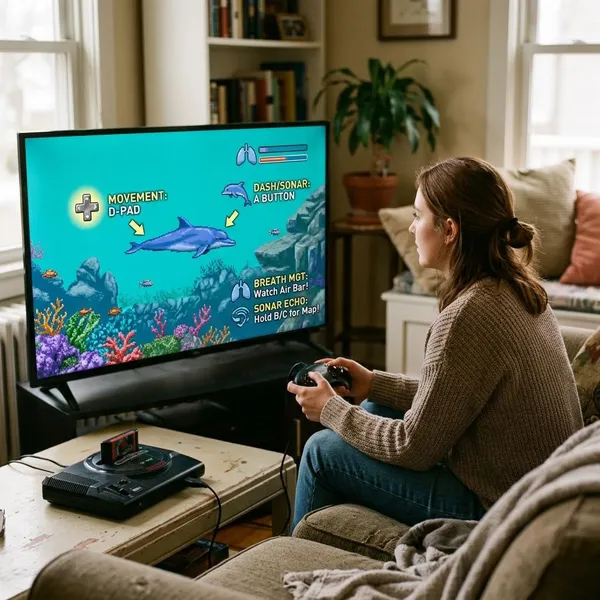
Beginner tips for Ecco the Dolphin
The best beginner mindset is simple: play carefully, not quickly. Ecco becomes much more readable when you stop trying to force progress and start building a safe route through each area.
Watch your air meter
Keep the air meter as your main concern, especially in new areas. A risky path is much safer with full air and a known return route; the same path can be a bad idea if you are already low.
Use sonar often
Use sonar before you decide a room is pointless. Nearby creatures may give hints, and some spaces only start to make sense when you interact instead of simply swimming through them.
Explore before rushing ahead
A slow first pass saves time later. Look for breathing spots, currents, enemies, narrow tunnels, and unusual walls before you commit to a route. This matters even more if you are playing without save states, because careless rushing can turn one missed clue into a full restart.
Expect trial and error
Repeated attempts are part of the game's old-school design. The useful question after a failure is not just "How did I die?" but "What did this teach me about the route?"
If that sounds annoying, the original may not be the best casual pick. If you enjoy slowly turning confusion into mastery, Ecco's difficulty becomes easier to respect.
Conclusion
Ecco the Dolphin is still worth playing because it feels unlike most retro action games: beautiful, tense, lonely, and sometimes genuinely unsettling. Start with the original if you want the full cult-classic experience, choose Ecco Jr. if you want a gentler first step, and give yourself permission to use modern conveniences if the difficulty gets in the way of enjoying the atmosphere.
FAQ
Is Ecco the Dolphin a horror game?
No. It is an action-adventure game, but its isolation, sound design, alien imagery, and sudden danger can make it feel horror-adjacent.
Are the Ecco the Dolphin games connected?
Some are. The original and Ecco: The Tides of Time are closely linked, Ecco Jr. is a lighter spin-off, and Defender of the Future uses its own rebooted continuity.
Is Ecco the Dolphin suitable for beginners?
Yes, but the original is not beginner-friendly by modern standards. New players who mainly want a relaxed start may be better off trying Ecco Jr. or using save states with the first game.