What Makes Prey Such a Memorable Sci-Fi Game?
Prey (2017) is worth a look if you want a sci-fi game where careful exploration matters more than pure shooting. Its best qualities are Talos I, the unsettling Typhon threat, and the freedom to solve problems in several clever ways. If you prefer fast, linear action, it may feel slow at first, but players who like choice-driven design usually get much more out of it.

What is Prey (2017)?
Prey is a first-person sci-fi immersive sim developed by Arkane Studios and published by Bethesda Softworks. It mixes combat, stealth, exploration, survival pressure, and character upgrades, but it is not designed like a standard shooter. The main appeal is choosing how to deal with a locked room, a dangerous enemy, a broken system, or a route that seems impossible at first.
A sci-fi game from Arkane Studios
Arkane's design style is a big reason Prey still stands out. The studio is known for spaces that feel hand-built rather than decorative, and Talos I follows that idea closely. Offices, labs, service tunnels, crew cabins, security systems, and exterior station routes all feed into how you move and make decisions.
The sci-fi setting is not just visual dressing. Experimental technology, alien biology, neuromods, and station infrastructure all affect how the game plays. A lab can be a story space, a puzzle, a resource source, or a trap depending on what you notice.
An immersive sim set on Talos I
Calling Prey an immersive sim is accurate because the game rarely gives only one intended solution. A locked door might be handled through hacking, a keycard, a vent, a code found on a corpse, a route through space, or a GLOO Cannon path up a wall.
- Check the room before fighting: vents, terminals, objects, and hazards often matter.
- Use tools in odd ways: many items solve movement and access problems, not just combat.
- Accept messy solutions: running, hiding, luring enemies, or returning later can be smarter than forcing a fight.
A survival story centered on Morgan Yu
Morgan Yu's role gives the game its personal hook. Morgan is not a random survivor walking into someone else's disaster; the station's experiments, memory loss, and ethical failures are tied directly to Morgan's past. That makes every new discovery feel less like background lore and more like evidence.
What is the story of Prey?
The story begins with Morgan waking up into what seems like an ordinary day, then quickly revealing that something is badly wrong. Memories are missing, the station is in crisis, and hostile aliens known as the Typhon have escaped containment. The immediate goal is survival, but the stronger pull is figuring out what Talos I was really doing before everything collapsed.
Morgan wakes up with missing memories
The opening twist puts the player and Morgan in the same position: confused, suspicious, and short on reliable context. Morgan's missing memories are not just a convenient way to explain the controls. They raise the bigger question of whether past choices still define you if your memory has been altered or removed.
This matters during quieter moments. You may find recordings or messages from versions of Morgan who thought differently from the Morgan you are playing now. That gap gives the story a sharper edge than a simple "escape the alien outbreak" plot.
The Typhon overrun Talos I
The Typhon make Talos I feel unsafe because they do not behave like ordinary shooter enemies. Mimics can hide as mugs, chairs, tools, or other everyday objects, so even a quiet office can feel suspicious. Larger Typhon add pressure through psychic attacks, environmental hazards, and sudden ambushes.
If you dislike constant jump scares, Prey is still manageable for many players because its horror is more about paranoia and resource tension than nonstop shock. If you hate being cautious in every room, though, the early hours may feel stressful rather than exciting.
Morgan uncovers the station's hidden experiments
As Morgan digs deeper, Talos I becomes less like a noble research facility and more like a place where progress was allowed to outrun ethics. Neuromods can grant abilities, but they are also connected to memory loss, testing, and human cost. The Typhon are not simply monsters that appeared from nowhere; the station's own work helped create the crisis.
What makes Prey an immersive sim?
Prey feels like an immersive sim because its systems overlap. Weapons, powers, physics objects, turrets, terminals, resources, enemy behavior, and level layouts can all interact. The important habit is not "shoot better"; it is "read the situation first."
A player who invests in hacking may open routes and disable threats through terminals. A player who favors engineering can repair systems, move heavy objects, and make better use of turrets. Someone leaning into Typhon powers may bypass barriers in stranger ways, but that choice can also affect how the station responds.
Multiple paths through each area
Most areas in Prey reward patience. If a door is locked, that usually means "find another angle," not "stop here." Look for vents, broken windows, exterior access, keycodes, bodies with keycards, climbable surfaces, and systems you can repair or hack.
Tools and powers with creative uses
The GLOO Cannon is the easiest example of Prey's design philosophy: it freezes enemies, seals hazards, puts out flames, and creates climbable ledges. It is not just a weapon; it changes how you see walls, ceilings, and broken spaces.
- GLOO Cannon: useful for climbing, blocking hazards, and controlling enemies.
- Recycler Charge: clears clutter, converts objects into materials, and can damage threats.
- Huntress Boltcaster: weak as a weapon, but handy for distractions and remote button presses.
- Typhon powers: open unusual routes, but may come with practical consequences.
Systems that react to player choices
The game does not pretend that every choice changes the entire world, but it does make decisions feel meaningful. How you spend resources, whether you help survivors, how much you explore, and whether you use alien powers can all affect the difficulty, tone, and outcome of your run.
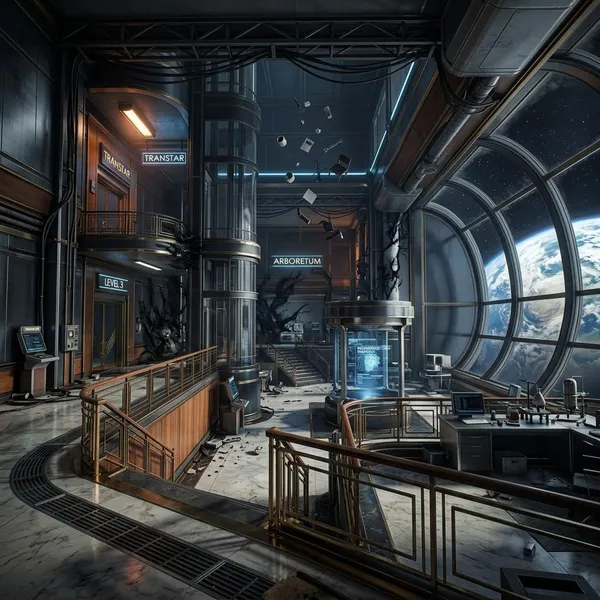
What makes Talos I stand out?
Talos I is one of the main reasons people still recommend Prey. The station feels connected, lived-in, and damaged in believable ways. Instead of moving through disconnected levels, you gradually learn a place with its own routines, shortcuts, departments, and secrets.
The best way to enjoy Talos I is to slow down without becoming obsessive. Search enough to understand the space, but do not feel forced to clear every drawer unless you enjoy that kind of play. The game rewards curiosity, not checklist completion.
Interconnected areas with hidden routes
Talos I loops back on itself in useful ways. A maintenance shaft may connect to an office, the station exterior may lead to a sealed area, and a later ability may turn an old obstacle into a shortcut. This structure makes revisiting areas feel purposeful rather than padded.
Environmental stories throughout the station
The station tells many of its best stories through details: a half-finished meal, a locked cabin, a tense email chain, a barricaded hallway, or a workstation left open in panic. These small clues make the crew feel like people who had routines and conflicts before the disaster.
For players who usually skip logs, Prey is a rare case where reading some of them pays off. They often point toward useful codes, hidden stashes, side objectives, or emotional context that changes how a room feels.
Distinct spaces built for exploration
Talos I has a strong art deco-inspired look, but its real strength is how different areas change your behavior. Crew quarters encourage slow story discovery. Labs make you suspicious of experiments and specimens. Industrial areas feel more exposed and risky. Exterior sections turn the station into a navigable object instead of just a backdrop.
If you are playing mainly for atmosphere, take time in each major area before pushing the next objective. If you are playing mainly for mechanics, pay attention to how each department introduces different route options and hazards. Both approaches are valid, and the game supports both better than most sci-fi shooters.
Who should play Prey?
Prey is easiest to recommend to players who like exploration, atmosphere, and flexible problem-solving. It is less ideal for someone who wants a short, cinematic shooter with constant forward momentum. The first thing to check is your patience for searching rooms, reading clues, and making imperfect decisions with limited supplies.
Immersive sim fans
If you enjoy System Shock, Deus Ex, or Arkane's Dishonored, Prey is a strong match. It gives you layered spaces, build choices, and problems that usually have more than one answer. The fun comes from noticing an option the game did not loudly point out.
Sci-fi and horror fans
Sci-fi fans get an orbital station, alien research, body-and-mind experimentation, and a mystery built around identity. Horror fans get tension, isolation, and enemies that make familiar spaces feel unsafe. The tone is uneasy rather than purely terrifying.
Players who enjoy exploration and choice
Prey is especially rewarding if you like asking, "Can I get in there another way?" Side paths often lead to useful supplies, crew stories, alternate routes, or information that changes how you understand Morgan's situation.
- Play it for exploration: if you like secrets, shortcuts, and environmental clues.
- Play it for choice: if you want your build and behavior to affect the experience.
- Skip or wait: if you want simple progression, generous ammo, and constant action.
Conclusion
Prey (2017) remains worth playing because its strongest parts still feel unusually well connected: Morgan's mystery, the Typhon threat, Talos I's layout, and the freedom to solve problems your own way. It is not the best choice for a quick, frictionless action game, but if you want a thoughtful sci-fi experience that rewards caution and curiosity, Talos I is still one of the most memorable places to get lost in.
FAQ
Is Prey connected to the original Prey?
No. Prey (2017) has a separate story, setting, and design style from the 2006 Prey, so you do not need to play the original first.
How long does Prey take to finish?
A focused run often takes around 15 to 25 hours, while a slower playthrough with side quests, logs, and thorough exploration can take longer.
Does Prey have multiple endings?
Yes. The ending is affected by your choices and behavior across the game, not only by a single final decision.