What Order Should You Watch the Fate Anime In?
The Fate anime collection is much less confusing once you stop treating it as one straight timeline. For most first-time viewers, the safest route is Fate/stay night: Unlimited Blade Works, then Heaven's Feel, then Fate/Zero; after that, spin-offs and Grand Order are easier to place.
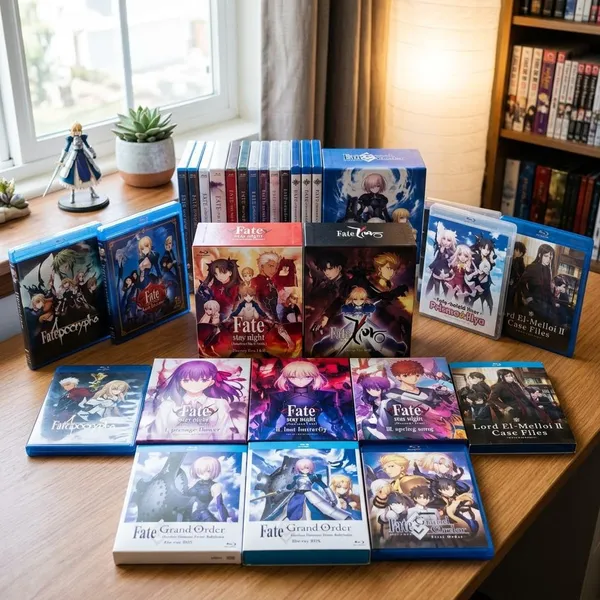
What is included in the Fate anime collection?
The first thing to check is which branch a title belongs to. Some Fate anime adapt different routes of the same original story, while others use the same ideas in alternate worlds. That is why two shows can both be "Fate" without being direct sequels.
| Branch | What it does | Best time to watch |
|---|---|---|
| Fate/stay night | Main foundation with Shirou, Saber, Rin, Sakura, servants, and the Fifth Holy Grail War | Start here if you want the clearest base |
| Fate/Zero | Prequel about the Fourth Holy Grail War | After at least one main route if you care about spoiler impact |
| Spin-offs | Alternate versions, different settings, and rule changes | After the main story, unless one premise strongly appeals to you |
| Fate/Grand Order | A separate Chaldea story adapted from the mobile game | Later, especially for anime-only viewers |
Fate/stay night as the main story
Fate/stay night is the branch to prioritize because it teaches the basic language of the franchise: masters, servants, noble phantasms, the Holy Grail War, and the emotional roles of Saber, Rin, Sakura, Shirou, and Archer.
Fate/Zero as the prequel
Fate/Zero happens before Fate/stay night, but "earlier in the timeline" does not automatically mean "best first watch." It explains the Fourth Holy Grail War and gives background for Kiritsugu, Kirei, and Waver, while also revealing things that later routes treat as discoveries.
If you want a darker war drama and do not mind learning background early, starting with Zero can work. If you want the cleaner mystery and character payoff, save it until after Unlimited Blade Works and Heaven's Feel.
Alternate-world spin-offs
Most spin-offs are better treated as "what if Fate used its rules differently?" rather than as required chapters. Apocrypha turns the war into a faction battle, Extra moves into a game-like setting, and Prisma Illya changes the tone almost completely.
Fate/Grand Order as a separate branch
Fate/Grand Order follows Chaldea, singularities, and a much larger save-human-history structure. It borrows plenty of Fate concepts, but it is not a replacement for Fate/stay night.
Anime-only viewers should expect gaps because the adaptations do not cover every game chapter. That is not a deal-breaker, but it means Grand Order works best once you are already comfortable with Fate's basic ideas.
How do the three Fate/stay night routes fit together?
The three Fate/stay night routes are parallel versions of the same starting situation, not a simple season-one, season-two, season-three sequence. Each one follows different choices and highlights a different heroine, while also changing what the story reveals about Shirou and the Grail War.
For a practical anime-only path, use this order:
- Fate/stay night: Unlimited Blade Works TV series
- Fate/stay night: Heaven's Feel movie trilogy
- Fate/Zero
- Fate/stay night (2006), optional if you want the Saber route
If you are only testing whether Fate is for you, start with Unlimited Blade Works and decide after a few episodes. If you already know you want the most complete anime picture, include the 2006 series later for Saber's route, even though it has aged more than the newer adaptations.
Fate as the Saber route
The Fate route is Saber's route, and it is the most direct introduction in the original visual novel. Its anime form is mainly the 2006 Fate/stay night series, which is useful for Saber's character but weaker as a modern first recommendation.
Watch it if Saber becomes your favorite or if you want to understand why longtime fans still talk about the missing "ideal" adaptation of her route. Skip it at first if older pacing and visuals would make you bounce off the franchise.
Unlimited Blade Works as the Rin route
Unlimited Blade Works is the Rin route in broad terms, but its real strength is the conflict around Shirou and Archer. It questions Shirou's dream of becoming a hero and gives newcomers enough rules and action to follow the story without feeling buried in lore.
Heaven's Feel as the Sakura route
Heaven's Feel is Sakura's route and the darkest part of the main Fate/stay night anime path. It assumes you already know the cast and then starts pulling apart what looked familiar.
That is why it is a poor first stop but a strong second one. After Unlimited Blade Works, the movie trilogy feels like a deeper, riskier version of the same world rather than a confusing jump into tragedy.
Which Fate spin-offs can you watch after the main story?
After the main story, pick spin-offs by mood instead of trying to force a perfect order. The most common mistake is treating every Fate title as mandatory homework. Most side entries are optional, and they are more fun when you choose the one that matches what you liked.
- Want more large-scale battles? Try Fate/Apocrypha.
- Liked Waver in Fate/Zero? Go to Lord El-Melloi II Case Files.
- Want something weird and symbolic? Save Fate/Extra: Last Encore for later.
- Curious about a very different tone? Treat Prisma Illya as a side experiment, not a normal Fate entry.
Fate/Apocrypha
Fate/Apocrypha is one of the easiest spin-offs to watch after the basics. It takes place in an alternate timeline and changes the usual Grail War into a larger conflict between two teams of servants.
It is a good pick if you want a more action-heavy weekend watch and do not need every character arc to be as focused as Fate/Zero. The bigger cast is the appeal, but it also means some characters get less depth.
Fate/strange Fake
Fate/strange Fake uses familiar Fate ideas without acting like a direct sequel to Fate/stay night. Its hook is an imperfect Grail War in the United States, where the ritual itself feels unstable.
Save it until you know what a normal Grail War usually looks like. The broken rules are much more interesting when you can spot what is being twisted.
Lord El-Melloi II Case Files
This is the natural follow-up if Waver Velvet was one of your favorite parts of Fate/Zero. Lord El-Melloi II Case Files follows him later in life and spends more time on mage society, investigations, and the Clock Tower than on servant battles.
Fate/Extra: Last Encore
Fate/Extra: Last Encore is optional and not beginner-friendly. It is tied to the Fate/Extra game setting, uses the Moon Cell, and often feels more abstract than explanatory.
If you like dreamlike anime that make you work for the meaning, it may be worth trying. If you mainly want clean continuity, put it near the bottom of your list.
Fate/kaleid liner Prisma Illya
Fate/kaleid liner Prisma Illya is a magical-girl alternate take on Fate characters, especially Illya. It can be funny, strange, action-heavy, and surprisingly serious later, but its tone is far from the main story.

How do you watch the Fate/Grand Order anime?
The workable anime order for Fate/Grand Order is First Order, Camelot, Babylonia, and then Solomon. This follows the adapted path through Part One, even though the anime skip earlier game chapters between the opening and the later singularities.
That gap matters more for some viewers than others. If you just want the major animated arcs, the order below is enough. If you need every relationship and chapter transition to feel complete, the game or a story recap will make the anime feel less abrupt.
- Fate/Grand Order: First Order
- Fate/Grand Order: Divine Realm of the Round Table: Camelot
- Fate/Grand Order: Absolute Demonic Front: Babylonia
- Fate/Grand Order: Final Singularity - Grand Temple of Time: Solomon
First Order begins the story
First Order introduces Chaldea, Mash, Fujimaru, the Fuyuki Singularity, and the basic problem of repairing human history. It moves quickly, but it gives you the minimum setup needed before the later arcs.
Camelot covers the Sixth Singularity
Camelot adapts the Sixth Singularity, so it jumps far ahead from the opening setup. Expect a harsher setting, the Knights of the Round Table, and a story that feels more serious than a simple adventure chapter.
Babylonia covers the Seventh Singularity
Babylonia covers the Seventh Singularity and is often the easiest Grand Order anime to enjoy on its own. The Mesopotamian setting, strong action, and memorable supporting cast make it feel more complete than you might expect from a late-game adaptation.
For anime-only viewers who are unsure about Grand Order, this is usually the point where the branch either clicks or clearly does not.
Solomon concludes Part One
Solomon belongs last because it is payoff, not setup. It assumes you already understand Chaldea's mission and have at least some attachment to the characters involved in the final confrontation.
Do not use it as a shortcut to "finish" Grand Order. Without the earlier entries, it loses most of its emotional weight.

Conclusion
The best Fate watch order depends on how much patience you have for older adaptations and side branches, but the strongest beginner path is still simple: Unlimited Blade Works, Heaven's Feel, then Fate/Zero. Once that foundation is in place, choose spin-offs by interest rather than obligation, and treat Grand Order as its own lane instead of the next required chapter.
FAQ
Can you start with Fate/Zero?
Yes, but it changes how later reveals land. Start with Fate/Zero if you prefer chronological tragedy; start with Unlimited Blade Works if you want the smoother anime-only introduction.
Is Fate/stay night (2006) required?
No, it is optional for most beginners. It matters mainly because it is the available Saber-route anime, so watch it later if you want a fuller view of the original route structure.
Is the Unlimited Blade Works movie the same story as the TV series?
It adapts the same route, but the TV series is the better choice. The movie is too compressed for a first watch and leaves less room for Shirou, Rin, and Archer's conflict to develop.
Is Fate/strange Fake connected to Fate/stay night?
Only loosely. It shares Fate concepts and benefits from knowing the usual Grail War rules, but it is not a direct continuation you need for the main story.