Who Are the Kantai Collection Characters and Ship Classes?
If you are trying to place the anime Kantai Collection characters in your head, start with two things: who the anime actually focuses on, and what ship class each girl represents. Fubuki, Mutsuki, Yuudachi, Akagi, Kaga, and Kongou are the easiest core names to learn first, while the larger game roster makes more sense once you understand destroyers, carriers, cruisers, and battleships.
What Are Kantai Collection Characters?
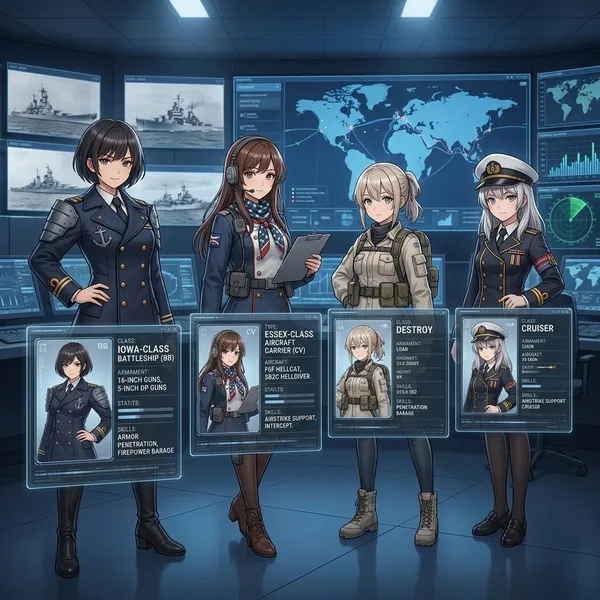
Kantai Collection characters are usually called Kanmusu, meaning "fleet girls." They are humanized versions of historical warships, mostly inspired by Imperial Japanese Navy vessels, with names, equipment, and combat roles tied to the ships they represent.
Warship-inspired Kanmusu
Kanmusu are not random anime girls with naval accessories. Fubuki, Akagi, Kaga, Kongou, Yamato, and many others take their names from real ships, and their gear often turns naval ideas into something readable on screen: aircraft for carriers, heavier rigging for battleships, and lighter, quicker-looking equipment for destroyers.
Characters grouped by ship type
Ship type is the easiest sorting tool. Destroyers are usually smaller, faster, and more emotionally close to the anime's everyday story. Aircraft carriers feel more composed and strategic. Battleships carry heavier presence and status. Light cruisers sit in the middle, often helping connect smaller ships with larger fleet operations.
- Anime-only viewer: learn the main girls first, then attach each one to her class.
- Game newcomer: learn the classes first, because the roster becomes much larger very quickly.
- Fan-art or merch browser: check whether a popular character is actually central in the anime or simply famous in the wider franchise.
Fleet roles based on naval classes
Class also explains what a character tends to do in combat. Destroyers often scout, escort, and move quickly. Carriers attack through aircraft from range. Battleships bring direct firepower and symbolic weight. Light cruisers often support, coordinate, or bridge the gap between smaller and heavier ships.
Main Kantai Collection Anime Characters
The TV anime narrows the franchise down to a manageable group. That is useful if you are starting from zero, because the game has far more Kanmusu than a single series can properly develop.
Fubuki
Fubuki is the anime's central protagonist and the best starting point for understanding the cast. She is a destroyer who begins unsure of herself, so her training and growth make the naval world feel less distant for new viewers.
Her value is not that she is the flashiest ship girl. She connects the audience to the fleet: through her, you meet destroyers at ground level, carriers as admired seniors, and battleships as heavier figures in the wider structure.
Mutsuki
Mutsuki gives the anime its softer emotional balance. She is a destroyer like Fubuki, but her role is less about becoming the lead fighter and more about friendship, morale, and the everyday cost of fleet life.
Yuudachi
Yuudachi is one of the easiest destroyers to recognize because of her energy, speech pattern, and stronger scene presence. She keeps the destroyer group from feeling like a set of similar junior characters.
Akagi
Akagi is one of the anime's defining aircraft carriers. She comes across as calm, skilled, and respected, which makes her an aspirational figure rather than just another powerful unit.
For Fubuki, Akagi represents the level of confidence and usefulness she wants to reach. For viewers, Akagi is also the cleanest early example of how carrier combat differs from destroyer movement: she projects force through aircraft and range.
Kaga
Kaga shares the aircraft carrier role with Akagi, but she feels sharper and more reserved. That contrast is important because it shows that ship class is only the base layer; personality still separates characters within the same role.
Kongou
Kongou is a battleship, so she naturally represents heavier firepower and stronger battlefield presence. What makes her memorable is that she does not feel cold or distant; her lively personality gives the battleship class more color.
She is a good character to learn early because she makes the difference between ship classes obvious. A battleship in KanColle is not just a bigger destroyer. The class carries a different kind of authority, visual weight, and story energy.
Kantai Collection Characters by Ship Class
Sorting Kantai Collection characters by ship class is the cleanest way to avoid getting lost. Names matter, but class tells you what to expect first: speed, support, air power, or heavy force.
Destroyers including Fubuki and Shimakaze
Destroyers are the best entry point for the anime because Fubuki, Mutsuki, and Yuudachi keep the story close to training, friendship, and personal growth. They are usually quicker and lighter than the larger ship classes, and they often make the fleet feel more relatable.
Shimakaze is a common source of confusion. She is one of the most recognizable KanColle characters in the wider franchise, but she is not the main character of the 2015 TV anime. If you came from fan art, figures, or online clips, expect her reputation outside the show to be larger than her central story role.
Light cruisers including Sendai and Jintsuu
Light cruisers such as Sendai and Jintsuu help the fleet feel organized. They are not framed with the same beginner viewpoint as the destroyers, and they do not carry the same prestige as carriers or battleships, but they make the middle of the fleet believable.
Think of them as the practical bridge class: useful for coordination, support, and keeping smaller operations from feeling chaotic.
Aircraft carriers including Akagi and Kaga
Aircraft carriers are among the easiest classes to identify because their combat depends on planes. Akagi and Kaga give the anime a sense of distance, strategy, and seniority that destroyers cannot provide on their own.
Battleships including Kongou and Yamato
Battleships represent heavy firepower, durability, and prestige. Kongou is the most immediate anime example, while Yamato carries a much larger historical and franchise reputation even when her exact role depends on the adaptation or context.
Other fleet members
KanColle also includes heavy cruisers, submarines, and other specialized fleet members. The anime cannot give all of them equal attention, but their presence hints that the world is much bigger than the main TV cast.
- Check the gear first: aircraft, heavy guns, torpedo-focused equipment, and rigging size usually reveal the role.
- Use group scenes: characters shown training or operating together often share related fleet functions.
- Do not over-rank cameos: a brief anime appearance may still belong to a major game character.
How Are Kantai Collection Characters Based on Warships?
The warship connection is the reason the cast has a built-in logic. Names, classes, equipment, and even a character's perceived status often come from the ship behind her.
It is still a fictional anime interpretation, so it should not be treated as a naval history source. But as a character system, it gives KanColle a stronger identity than a normal school-action cast with military decoration added on top.
Names come from historic warships
Most major Kanmusu names come from real Japanese warships. Fubuki, Akagi, Kaga, Kongou, and Yamato are not just stylish names; they point back to vessels with specific classes and reputations.
Ship classes shape character types
Ship class gives each character a starting shape. A destroyer lead like Fubuki fits a growth story because she can begin small and work upward. A carrier like Kaga can feel polished from the start. A battleship like Kongou can enter a scene with immediate presence.
The important detail is that class does not fully define personality. Akagi and Kaga are both carriers, but they do not feel identical; Fubuki and Yuudachi are both destroyers, but they bring very different energy.
Naval roles influence combat styles
Combat style follows role closely enough that viewers can read battles without needing technical ship knowledge. Destroyers move quickly, carriers use aircraft, battleships hit heavily, and cruisers often fill flexible support positions.
That makes the action more useful for character recognition. When you see how a girl fights, you are also learning where she belongs in the fleet.
Historical details inspire character designs
Historical inspiration often appears as visual shorthand rather than exact realism. Rigging, weapons, aircraft, posture, and status cues all help translate a ship's role into an anime character design.
- Carrier cues: aircraft, flight-deck imagery, and a more strategic battle style.
- Destroyer cues: lighter equipment, quicker movement, and a more youthful or energetic tone.
- Battleship cues: heavier rigging, stronger presence, and a sense of command or prestige.
Kantai Collection Anime Cast vs Game Roster
The anime and game use the same basic concept, but they do not handle the cast in the same way. The anime needs focus, so it follows a smaller group. The game is built around a much broader roster, so it rewards long-term collecting and character discovery.
The anime follows a smaller cast
The anime keeps the spotlight narrow so viewers can follow Fubuki's growth, her friendships, and the fleet's basic class structure without being buried under names.
That makes it a good starting point if you want story first. You get enough destroyers, carriers, and battleships to understand the setting, but not so many that every scene becomes a roll call.
The game includes many more Kanmusu
The game expands far beyond the TV anime's main group. It includes many more destroyers, cruisers, carriers, battleships, submarines, and specialized ships, which is why game-based character discussions can feel much wider than anime-only ones.
If your goal is to choose favorites, browse designs, or understand why certain characters are popular despite limited anime time, the game roster is the better reference point. The anime introduces the idea; the game shows the scale.
Some game characters have minor anime roles
Some game-known Kanmusu only appear briefly in the anime. That does not necessarily mean they are unimportant to the franchise; it usually means the TV story did not have room to develop them.
- Use the anime for the core cast: Fubuki and the main supporting group are the cleanest starting point.
- Use the game for breadth: many fan-favorite characters live mostly outside the anime's central plot.
- Treat cameos carefully: a short appearance may be a small nod to players, not a sign that the character will matter later in the show.
Conclusion
The most useful way to approach KanColle is to learn the anime's core characters first, then sort everyone else by ship class and role. Fubuki gives you the emotional entry point, Akagi and Kaga show carrier prestige, Kongou makes battleship power easy to recognize, and the wider game roster can wait until those basics feel natural.
FAQ
What does Kanmusu mean?
Kanmusu means "fleet girls." In Kantai Collection, it refers to girls who personify warships rather than ordinary sailors or pilots.
Is Shimakaze a main character in Kantai Collection?
Shimakaze is famous in the wider KanColle franchise, but she is not the main lead of the 2015 TV anime. For the anime story, Fubuki is the character to follow first.
Are KanColle and Azur Lane related?
No. KanColle and Azur Lane are separate franchises with different casts, stories, and game systems, even though both use warship-inspired anime girls.